
Talking AI Avatars in 2026: How They Work, What They Cost
How talking AI avatars are built, what each production route costs per ad, which niches they win, and the disclosure rules you follow before you run them.

On this page
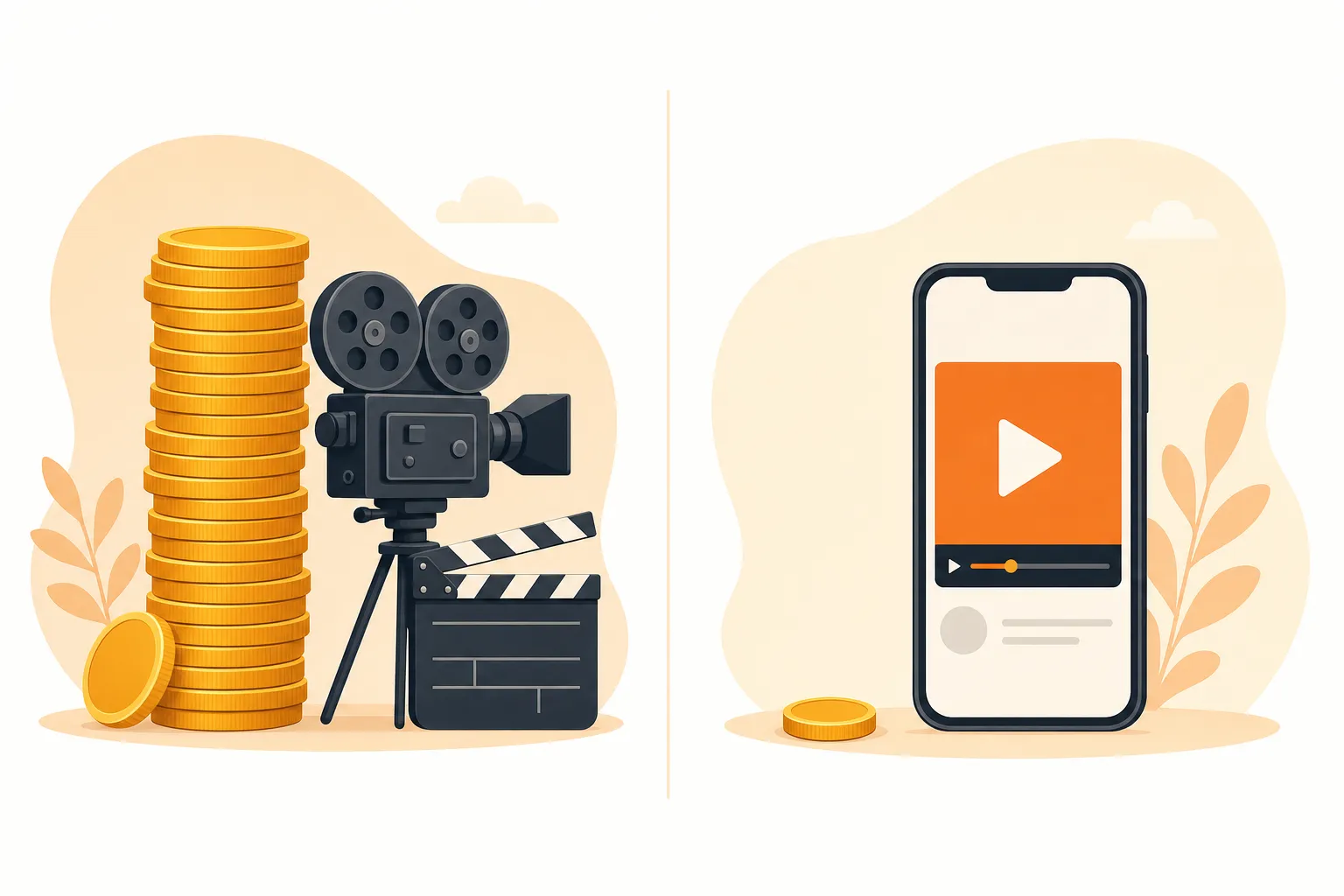
A talking AI avatar is a synthetic presenter who delivers your script to camera — no shoot, no actor, no studio. The economics are the reason the format went mainstream: a human UGC creator costs $500–$2,000 per video with a 7–14 day turnaround at current marketplace rates (tracked publicly by Insense and Billo), while a rendered avatar delivers the same 30 seconds in minutes at single-digit dollars. Adoption is no longer the interesting question — XR Extreme Reach's State of Ad Ops study (September 2026, 400+ US and UK advertising professionals, covered by Adweek) found 88% of advertisers actively using or piloting AI in creative production, with nearly half using it daily.
Craft is the question. Two teams can rent the same avatar library and get wildly different results, because what decides a talking-avatar ad is not the model — it is framing, delivery, script discipline, and the disclosure rules you follow before it goes live. This playbook covers all four, plus the real per-ad cost across every production route shipping in 2026.
The three routes to a talking avatar (they are not interchangeable)
"Talking AI avatar" is used loosely to describe three very different production setups. Picking the wrong one is the most common reason a first attempt looks synthetic.
| Route | What you supply | What comes back | Best fit |
|---|---|---|---|
| Avatar library + lip-sync | Script (and optionally a scripted voice) | A rendered person speaking your lines, captioned and ready to cut | Testimonial-format ads, product explainers, localization |
| AI actor marketplace | Script only | An actor-style UGC take with ad-context realism | Performance teams already fluent in hooks and editing |
| Text/image-to-video models | Prompt, product images, or reference footage | Cinematic b-roll, product motion, scene footage — no lip-sync anchor | The non-talking half of the ad: product reveals, texture shots |
The distinction matters because route three cannot carry a spoken pitch on its own and route one cannot invent footage that does not exist. Most high-performing 2026 ad units combine two of the three: a lip-synced presenter carrying the hook and the benefit, generative or stock footage carrying the product.
What makes an avatar read as human
Five details separate an ad that passes as a real person from one that reads as a demo reel. All five are controllable in any of the tools above.
- Framing. Phone-distance, handheld, face in the upper third, 9:16 throughout. An avatar framed like a corporate keynote reads as corporate no matter how good the lip-sync is. The mirror-selfie and car-interior framings exist because they are the two setups a real customer would actually film in.
- Delivery. The hook is 8–12 words. A person speaks in contractions, restarts mid-clause, and does not pause for a full stop after every benefit. Scripts written the way people talk beat scripts written the way decks read — this is the single highest-leverage edit you can make, and it costs nothing.
- Audio. Room tone beats studio silence. An avatar with a perfectly dead acoustic space sounds processed; a little kitchen or car ambience does the opposite. If your platform exposes filler-word handling, keep some of it — Prizmad's AI Studio ships HeyGen filler-word removal when you need the opposite direction and want a cleaner take.
- Captions. Burn them in, word-level, inside the platform safe zones. Most of your feed impressions are sound-off, and captions are also how the hook survives a muted scroll.
- Motion. Micro-movement, not idle sway. If the presenter's head travels in a smooth loop, the frame reads as generated. Alternative takes help here: render the same line twice and pick the less rehearsed one.
Anatomy of a talking-avatar ad
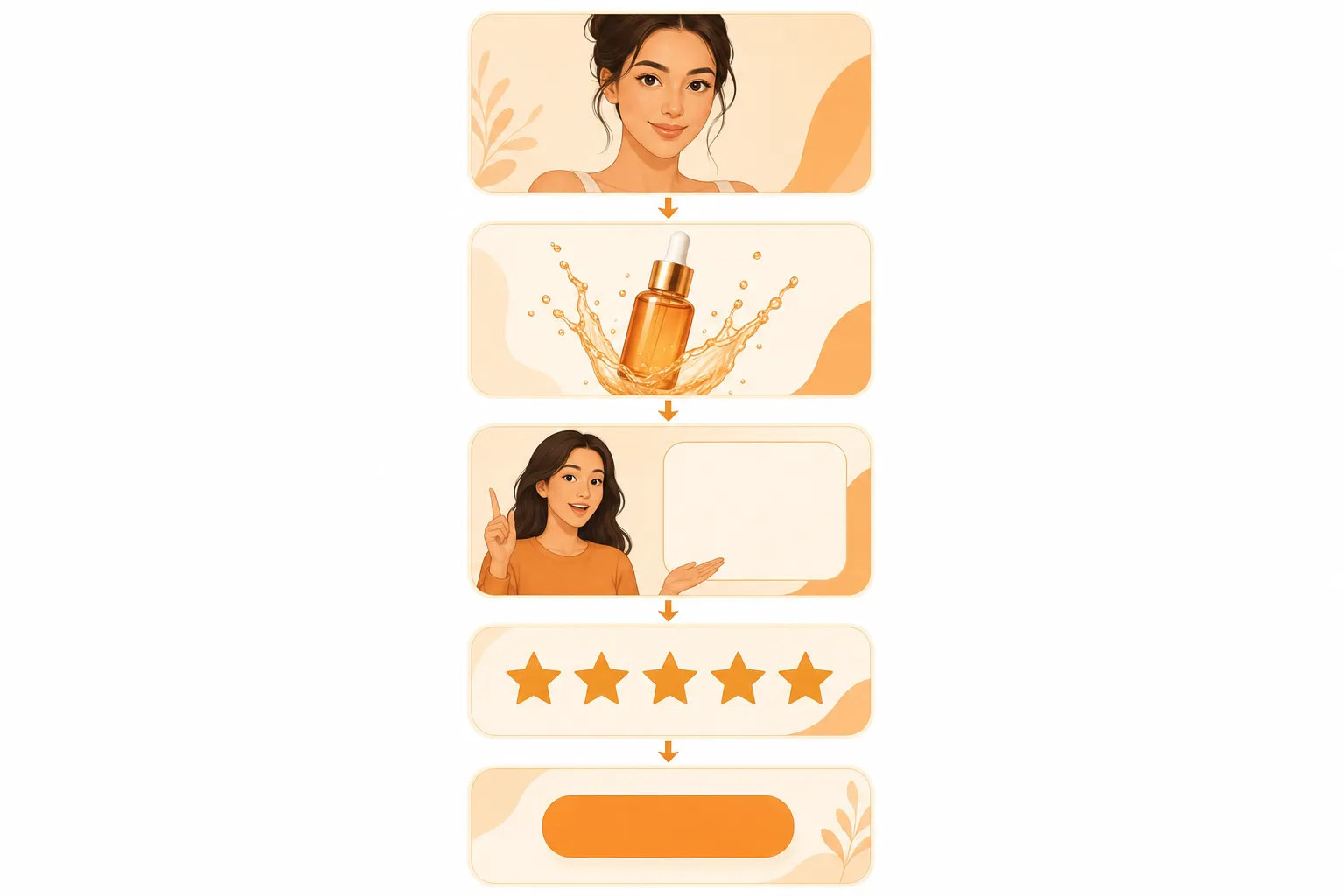
The format that converts in 2026 has five beats, and each one maps to a specific step in production:
- Hook (first 1.5 seconds). Pattern-interrupt visual plus a spoken claim that names the audience or the problem. Example: "If your serum pills under makeup by noon, this is why."
- Problem (seconds 2–6). The avatar names the frustration in the customer's words. No product yet.
- Product reveal (seconds 6–15). The product appears in motion — generative b-roll or a shot built from your product images — while the avatar carries the core benefit.
- Proof beat (seconds 15–22). Ratings, review counts, a specific number, or a demo moment. Use real review data only: an AI presenter cannot honestly deliver a fabricated testimonial, and platform review systems are not the place to test that theory.
- Call to action (final 3–5 seconds). Price, offer, deadline, or the simplest possible next step. One CTA, spoken and shown.
Per-niche playbooks
The avatar archetype, tone, and compliance pressure change per category. Five that consistently outperform a generic template:

Beauty and skincare
Avatar archetype: bathroom-mirror, natural light, minimal makeup. Tone: confiding, slightly skeptical before the reveal. Hook: "I stopped using three products and my skin got better — here is what actually mattered." Compliance note: no before/after implied transformation in the creative, and no medical claims about acne or pigmentation — the claim has to be cosmetic and demonstrable on camera.
Supplements and wellness
Avatar archetype: kitchen or gym, morning light. Tone: matter-of-fact, no hype words. Hook: "I take one thing every morning and it is not the expensive one." Compliance note: this is the highest-risk vertical. Structure/function claims need the standard disclaimer, "prevents/cures/treats" language is off the table, and any testimonial structure must stay clearly positioned as the brand speaking rather than a customer speaking.
Apparel and accessories
Avatar archetype: mirror-selfie, full outfit in frame, phone visible in hand. Tone: fast, slightly unpolished, sizing-specific. Hook: "I am five foot four and this is the only length that does not swallow me." Compliance note: show the actual product, not a generative approximation — a synthetic garment that differs from what ships is a returns problem and a policy problem.
Home and furniture
Avatar archetype: standing in the room being described, product in background. Tone: measured, spatial, uses dimensions. Hook: "This is a 9-foot wall and the sofa finally fits it." Compliance note: avoid generative "room" footage that implies a product feature the item does not have — pair the avatar with real product imagery and label any concept visual.
Jewelry and gifting
Avatar archetype: close-up, hand-held product, tight framing. Tone: warm, occasion-driven. Hook: "This is the gift that does not need a size." Compliance note: price and offer claims must match the landing page exactly; the gift-occasion angle invites urgency language, which is where aggressive scarcity claims get flagged.
Production workflow
Six steps produce a testable talking-avatar ad, whichever route you choose:
- Ingest the product truth. Name, price, offer, three real benefits, and the objections customers actually raise. Everything downstream inherits this.
- Write the hook first, in the customer's words. Eight to twelve words. Then write the other four beats to serve it.
- Choose the avatar archetype to match the niche. Not the most attractive one — the one a real customer in that category would be.
- Render the voice and the lip-sync. One pass, then a second take to compare micro-movement.
- Assemble: captions, product footage, music, CTA. This is where route one and route two both add work, and where an all-in-one pipeline already has everything composited.
- Test in pairs, not in bulk. Two hook variants against the same body, same avatar, same offer — so the result tells you which variable moved.
Prizmad collapses steps 1–5 into one pass: paste a product URL and the pipeline writes the script and hook from the page, casts one of 50+ avatars, generates the voiceover, and composites captions, product creatives, and music into a finished vertical ad in roughly five minutes. Its AI Studio sits beside that pipeline with 30+ models for the non-talking half of the work — b-roll, product shots, and reference-driven scenes — when you want to build the beats yourself.
What a talking avatar actually costs
Per-finished-ad cost, using published 2026 pricing. The uncomfortable finding is that the cheapest sticker is rarely the cheapest ad.
| Route | Published price | Per finished 30-second ad | What is not included |
|---|---|---|---|
| Human UGC creator | $500–$2,000 per video (marketplace rates) | $500–$2,000 | Nothing — but 7–14 days and re-negotiation per round |
| AI actor marketplace | Arcads $110/mo Starter for 10 videos (per third-party reports) | ≈$11 | No free plan or trial; higher tiers are contact-sales |
| Avatar platform, do-it-yourself | HeyGen $29/mo Creator: 600 credits ≈ 30 min of Avatar IV/V at 20 credits/min | ≈$0.50 per render | Script, captions, product footage, music, and assembly are your labour |
| Unlimited-render avatar platform | DeepBrain AI $24/mo Personal ($20/mo billed annually): unlimited videos up to 30 minutes each | Effectively flat | Dubbing minutes are the metered resource, not renders |
| All-in-one ad pipeline | Prizmad Launch $39/mo → 3,000 tokens ≈ 3 finished ads; Starter $99 → ≈8; Pro $249 → ≈35 | ≈$13 on Launch, ≈$12 on Starter, ≈$7 on Pro | Nothing for assembly — script, avatar, voiceover, captions, and music are in the render |
Read the table honestly and the trade-off is clear. Renting an avatar platform and assembling by hand is the cheapest per render — roughly fifty cents at HeyGen's credit math, or flat-rate at DeepBrain — but it buys a presenter, not an ad: you still owe a script that sounds like a person, captions, product footage, music, and the edit. Prizmad's ≈$13 per finished ad is more expensive per unit precisely because the expensive part is included. Teams with an in-house editor should do the DIY math; teams testing twelve variants a month without one should compare against their own hourly rate before assuming the cheap route is cheaper.
For a wider cost survey across human, studio, agency, and AI pipelines, see our AI video ads cost breakdown; for the tooling comparison itself, the AI UGC platforms hub puts the avatar libraries side by side with monthly prices verified per vendor.
Compliance: the part most teams get wrong
Talking avatars are legal, mainstream, and increasingly labelled. The failure mode is not the technology, it is the claim built on top of it.
- AI disclosure. Google added a "How this ad was created" panel to ads across Search, YouTube, and Discover in July 2026 and gives advertisers a control for labelling AI-generated creative made elsewhere; Meta and TikTok both require disclosure of realistic AI-generated content. Our AI ad disclosure guide walks the platform-by-platform version.
- Likeness and consent. Cloning a real person — yourself, a founder, an employee, a customer — requires written permission that covers paid ads, territory, and duration. Public figures are off limits entirely.
- Testimonials cannot be synthetic. An AI presenter may speak for the brand; it may not be presented as a real customer who bought and used the product. Endorsement rules treat fabricated customer voices as deceptive regardless of whether a human or a model performed them. Use real review quotes and real customer footage for the proof beat.
- Health, money, and outcome claims. Supplements, cosmetics with dermatological framing, and finance products carry their own platform restrictions in addition to advertising law. Assume any claim about a body or a bank balance needs review before it ships.
- Voice and music rights. Licensed voices and licensed music only — a cloned voice you do not have rights to is the same problem as an unlicensed track.
None of this is a reason to avoid the format; the disclosure tools exist precisely because the format is standard practice now. It is a reason to have the claim review happen before generation rather than after launch.
Frequently asked questions
What are AI UGC ads?
AI UGC ads (AI-generated user-generated content ads) are video advertisements that use AI avatars, synthetic voiceovers, and automated editing to replicate the authentic, creator-style content traditionally filmed by real influencers or users. Prizmad generates AI UGC video ads from any product URL in minutes — at a fraction of the cost of hiring human UGC creators.
How long does it take to generate a video?
Most videos are ready within 5 minutes. Complex ads with custom avatars may take up to 10 minutes. You'll receive a notification when your video is ready.
Do I need video editing experience?
Not at all. AI handles everything — from script writing to final editing. Just paste a product link, choose your preferences, and let the AI do the rest.
Do I need a product link to get started?
No! A link is optional. Paste a URL from Shopify, Amazon, WooCommerce, or any product page and everything gets extracted automatically. Or skip the link and describe your product manually.
Can I edit the AI-generated script?
Yes! After AI generates a script using proven ad hook formulas, you can review and edit every line before rendering. Full control over the final messaging.
What platforms can I publish to?
Export videos ready for TikTok, Instagram Reels, Facebook Ads, YouTube Shorts, Shopify, and Amazon. All standard formats are included: 9:16 (vertical), 1:1 (square feed), and 16:9 (landscape) — all in Full HD 1080p.
How does AI UGC compare to hiring human UGC creators?
Traditional UGC creators charge $500–$2,000 per video and take 1–3 weeks to deliver. AI UGC ads from Prizmad cost approximately $7–13 per video (depending on your plan), generate in about 5 minutes, and can be produced in unlimited variations for A/B testing — in 15 languages from a single product link.
Do I own commercial rights to my AI-generated ads?
Yes. You own full commercial rights to every video ad you generate with Prizmad. Use them on any advertising platform, in any market, for as long as you want — no additional licensing fees.
Is it legal to run AI-generated video ads on TikTok, Meta, and Google?
Yes. AI-generated video ads are permitted on major ad platforms including Meta (Facebook and Instagram), TikTok, Google, and YouTube, provided they comply with each platform's advertising policies and any applicable AI-content disclosure requirements. You own full commercial rights to every video ad generated with Prizmad and can run them on any advertising platform without additional licensing fees.
How do tokens work?
Each video generation costs tokens based on complexity. The Starter plan includes 8,000 tokens and the Pro plan includes 35,000 tokens. A finished UGC video ad with an AI avatar costs around 1,000 tokens; simpler videos without an avatar cost far less. Tokens refresh each billing cycle and don't roll over.
Can I cancel my subscription?
Yes, you can cancel anytime from your account settings. You'll keep access until the end of your billing period. No questions asked.
The format has stopped being novel, which is good news: nobody is impressed by a talking avatar anymore, so the ad has to win on the hook and the offer. Paste a product URL into Prizmad and you have a first variant in about five minutes — then spend the time you saved on the second hook.