
TikTok Spark Ads + AI UGC: The 2026 Whitelisting Playbook
TikTok Spark Ads in 2026: verified specs, creator authorization flow, per-niche whitelisting playbooks, and where AI UGC fits the paid pipeline.
On this page
Whitelisting is the most expensive way to buy TikTok ads — and the one that pays for itself when the creative is right. The core mechanic is simple: instead of shipping a branded video through Ads Manager, you take an organic post from a creator's account, get the creator to authorize it for advertising, and boost it as a Spark Ad under their handle. The ad keeps the comments, the shares, the profile visit, and the follow button of an organic post. TikTok's own numbers are aggressive: Spark Ads see a 134% higher completion rate and a 157% higher 6-second view-through rate than standard In-Feed Ads, and TikTok reports the Spark Ads profile landing page delivers a 69% higher conversion rate and 37% lower CPA than before that UI shipped.
The catch is production. A whitelisting engine needs a constant supply of native-feeling videos that look like a creator made them — hooks, product demos, testimonials — and that's exactly the bottleneck AI UGC pipelines were built to remove. This playbook covers the verified 2026 Spark Ads mechanics (pull vs push, authorization flow, specs), five per-niche whitelisting playbooks, the paid-organic test matrix, the cost math, and the compliance rules that keep whitelisted accounts alive.
Why Spark Ads are a different craft than In-Feed
Four things make Spark Ads structurally different from standard In-Feed advertising:
- The creator's account is the ad. The video runs under the original poster's handle, with their avatar, their caption, and their comment section. The ad is judged — and delivered — like the creator's content, not like a brand's. That's the authenticity TikTok's algorithm rewards, and it's why the 134%/157% engagement deltas exist at all.
- You're buying the interaction layer, not just the view. Spark Ads users can comment, like, share, follow, Duet, and Stitch. An ad that collects comments trains the algorithm the way organic content does, which compounds delivery over the campaign's life. Standard In-Feed ads do not get this.
- The post has to exist organically first (pull model). Either the creator or your brand account publishes the video to TikTok, and only then can it be authorized and boosted. That sequencing — organic post → proof of life → paid scale — is the whole discipline of whitelisting, and it's where most teams break: they have no organic-first content pipeline.
- Cost structure shifts from production to licensing. You now pay for the creator's fee (or the AI pipeline's output), not just the media buy. The economics only work when the creative unit cost stays low enough to test at volume — see the cost math section.
The 2026 Spark Ads spec sheet (verified against TikTok Ads Manager help)
Verified against TikTok's About Spark Ads help article, the Spark Ads creation guide, and the reservation in-feed ad specifications on the day this guide was written.
| Parameter | Spark Ads Pull (organic post) | Spark Ads Push / Non-Spark In-Feed |
|---|---|---|
| Source | Video already published on TikTok by the authorized account | Creative uploaded via Ads Manager |
| Aspect ratio | Any ratio the organic post supports (9:16 standard) | 9:16 ≥540×960 (recommended), 16:9 ≥960×540, 1:1 ≥640×640 |
| Duration | No restriction — all organic video lengths | 5–60 seconds (9–15s recommended) |
| File size | N/A (already on platform) | ≤500 MB |
| Format | .mp4 / .mov (as published) | .mp4, .mov, .mpeg, .3gp |
| Bitrate | N/A | ≥2,500 kbps for reservation / in-feed |
| Caption | Taken from the organic post; cannot be edited after authorization; blank captions supported | Ad text 1–100 characters (4–60 recommended) |
Spark Ads Pull has essentially no technical ceiling because the video already passed TikTok's upload pipeline. The constraints are procedural: the post must be authorized, the caption is frozen once authorized, and a private video becomes public the moment it's used in a campaign and stays public while the campaign runs.
Safe zones matter on both models. TikTok publishes per-placement safe zone overlays for the right column (CTA, profile photo, caption) — keep key text and logos inside the safe zone or they get covered or cropped. For Spark Ads the caption comes from the organic post, so a long caption physically shrinks the visible creative area; shorter captions mean more room for the video.
Anatomy of a whitelisting campaign
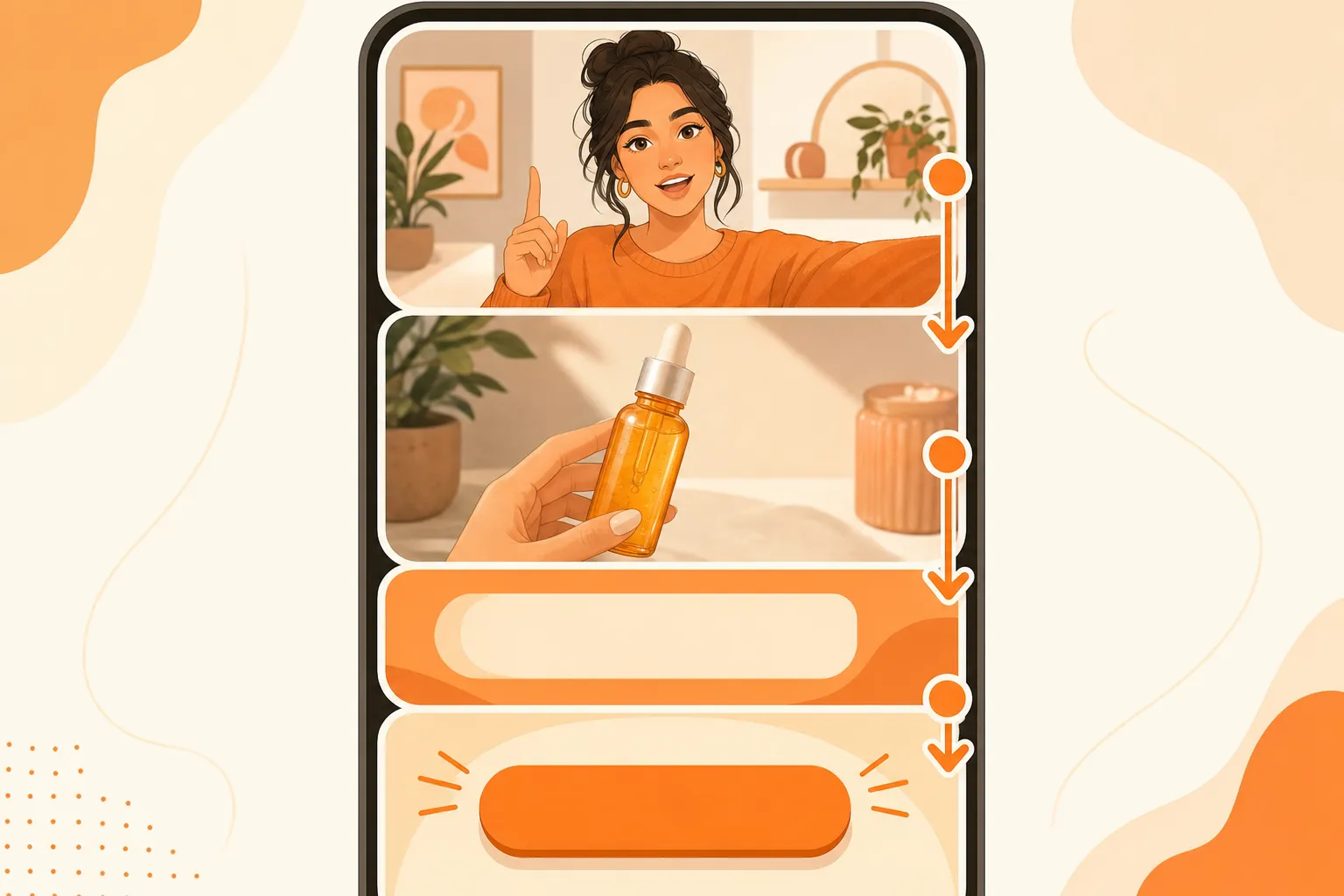
- Native hook — 0–2s. The video must open like the creator's normal content, not like an ad. "I've been testing this for two weeks…", "POV: you finally found a serum that works", "Don't buy this until you watch the whole thing". If the first frame looks like a brand spot, the algorithm and the viewer both treat it as an ad — and you lose the whitelisting advantage.
- Product proof — 2–15s. The creator demonstrates the product in their own setting: application, unboxing, side-by-side, routine. UGC-style proof beats studio polish here; the audience is comparing you to the organic videos around you, not to a commercial.
- Overlay text — continuous. Burned-in captions are essential because a large share of feed views happen muted. Keep overlay language honest and specific: the mechanism, the result, the limitation.
- CTA zone — last 1–2s + bottom third. TikTok adds its own CTA button (Shop Now, Learn More, Contact) plus the profile row. Keep the bottom ≈15–20% and the right rail clear of critical text so TikTok's UI never covers your message.
The authorization flow (creator → advertiser)
TikTok supports two directions, both documented in Ads Manager's Spark Ads creation guide:
- Pull — the advertiser imports an existing organic post. The post must come from a linked business account, an authorized TikTok account connected through Business Center, or a creator who shared an authorization code. The creator generates the code from the video's Ad settings in the TikTok app (Ad Authorization → generate code); advertisers can batch-authorize up to 20 video codes at a time. You cannot edit the post's caption after it's authorized — the caption you approve is the ad.
- Push — the advertiser builds the creative in Ads Manager and publishes it onto an authorized TikTok account, choosing identity, music, text, CTA, and destination. This is the faster route for AI-generated UGC, because you control the final cut without asking the creator to post first.
Two ownership rules worth memorizing: a private video becomes public once it runs as a Spark Ad and its privacy can't change while the campaign is live, and a video code can only be deleted after every ad that uses it is deleted. Whitelisting is a commitment, not a test.
Per-niche whitelisting playbooks
These five patterns hold up across DTC categories in 2026. Each is a hook + creator-tone + product-reveal + compliance combo, and each works with a real creator or with an AI UGC pipeline that mimics the native look.
Beauty and skincare
Hook: the skeptic's review. "I was today years old when I found out…" or "Everyone's raving about this — here's my honest week one." The tone is personal and slightly skeptical; beauty audiences are allergic to infomercial energy. Product reveal: application close-up with visible texture, then a routine shot. Compliance: keep claims cosmetic ("improves the appearance of fine lines"), never drug-territory ("reduces wrinkles", "treats acne"); see our beauty compliance playbook.
Supplements and wellness
Hook: the routine integration. "Three things I take every morning" — the supplement is one of three, which reads more native than a dedicated ad. Tone: calm, everyday, not hype. Product reveal: the jar in a kitchen/bathroom setting, the scoop, the morning routine. Compliance: structure/function claims only ("supports", "may help with"), never disease claims; weight-management claims require 18+ targeting and healthy-lifestyle framing on TikTok; see our supplements compliance playbook.
Apparel and fashion
Hook: the outfit transition or the try-on. "I ordered 5 dresses to find THE one" or a mirror transition. Tone: playful, trend-aware. Product reveal: full-body shot, fabric close-up, styling options. Compliance: honest sizing and availability — a dress shown in the video must exist in the sizes offered, and "limited" claims must be real. Fashion Spark Ads over-index on Duet/Stitch potential, so leave a beat that invites response.
Home and gadgets
Hook: the before/after or the "wait for it". "My countertop after this $40 organizer" or "This is 3 minutes of my life I want back". Tone: practical, slightly deadpan. Product reveal: the problem state first, then the product solving it. Compliance: no fake before/after (the transformation must be real and achievable), no misleading "as seen on TV" framing; TikTok's ad policies police exaggerated results in home and beauty equally.
Food and beverage
Hook: the recipe or the ASMR moment. "3-ingredient dinner I make every week" or a sound-on prep shot. Tone: warm, sensory. Product reveal: the finished dish, the ingredient close-up, the packaging at the end. Compliance: honest portion/calorie framing where claimed, no deceptive health claims, and use commercially licensed audio — food content lives on sound.
Where AI UGC fits the whitelisting pipeline
The honest question every DTC team asks: do Spark Ads require real creators? No — but they require native-feeling content, and that's a production spec, not an identity spec. AI-generated UGC (synthetic creators, scripted hooks, product demos) slots into whitelisting in three concrete places:
- Brand-account Spark Ads. Publish AI UGC to your own TikTok business account, then boost your own posts as Spark Ads. You keep full control, you skip creator licensing, and you still get the native interaction layer. This is the fastest legal on-ramp.
- Creator-library volume. For accounts whitelisting real creators, AI UGC is the A/B material: run the creator's organic post against an AI-generated variant with the same hook, and let the auction decide. The AI variant costs near zero to produce, so the test budget is trivial.
- Scaling winning hooks. Once a hook wins in testing, AI UGC lets you re-skin it across niches, products, and languages without re-shooting. A single proven structure can become 20 weekly variants — which is exactly the volume whitelisting needs to feed the always-on paid engine.
This is where Prizmad's URL-to-ad pipeline fits: paste a product URL, get a native-style 9:16 UGC ad in about five minutes, publish it to your TikTok account, and authorize it as a Spark Ad the same day. The token math makes the economics obvious — see below.
Cost math: whitelisting with creators vs AI UGC
The real budget question for a DTC brand running, say, 15 whitelisted videos a month (5 hooks × 3 variants, refreshed monthly):
| Channel | Cost per video | Turnaround | Monthly (15 videos) |
|---|---|---|---|
| Creator (micro, UGC licensing + management) | $150–$800 | 1–3 weeks | $2,250–$12,000 |
| Creator agency / managed whitelisting | $500–$2,000 | 2–4 weeks | $7,500–$30,000 |
| In-house editor + paid social lead | $200–$600 | 3–7 days | $3,000–$9,000 |
| AI UGC pipeline (Prizmad) | ≈$7–13 per finished ad | under 10 min | ≈$107–195, same day |
The AI line is based on current plan pricing: Launch $39/mo for 3,000 tokens (≈3 finished avatar ads), Starter $99/mo for 8,000 tokens, Pro $249/mo for 35,000 tokens (per Prizmad pricing). At Pro volume you can produce the entire monthly whitelisting batch in an afternoon, then spend the saved budget on the media buy — and for Spark Ads the media buy is where the return actually lives.
Compliance for Spark Ads and AI UGC
- Authorization is a hard requirement. You cannot boost a creator's post without their explicit ad authorization — that's the entire legal basis of the format. Confirm the code before you publish, and keep a record; TikTok's Spark Ads code error notifications exist precisely because this gets done wrong.
- AI disclosure. TikTok requires clear disclosure of AI-generated content in ads that use realistic synthetic media, including synthetic performers. TikTok's own transparency settings let viewers label AI content — if your AI UGC features a realistic-looking presenter, label it. Our AI ad disclosure guide has the full platform-by-platform breakdown.
- Paid partnership framing. When a real creator's organic post is boosted as a Spark Ad, the comment section and post context still look organic — TikTok's ad review checks that the post complies with ad policies even though it reads native. Keep claims substantiated and honest; "ad-like" review standards apply to the whole post, caption included.
- Caption permanence. The caption is frozen at authorization. Write the final caption before you authorize — including the disclosure and any required fine print — because you can't fix it later without a re-post.
- Licensed music. Spark Ads inherit the organic post's audio. If the audio is a licensed track, its commercial terms apply to the ad — use TikTok's Commercial Music Library for guaranteed-safe tracks, and keep AI voiceover as the safe default.
Frequently asked questions
What is Prizmad?
Prizmad is an AI ad agent for ecommerce brands. Paste a product link or describe your product in a chat, and the agent — trained on 60M+ ad creatives — writes the hooks and script, casts an AI actor and voice, and delivers ready-to-post video ads for TikTok, Reels and Shorts in about 5 minutes.
What are AI UGC ads?
AI UGC ads (AI-generated user-generated content ads) are video advertisements that use AI avatars, synthetic voiceovers, and automated editing to replicate the authentic, creator-style content traditionally filmed by real influencers or users. Prizmad generates AI UGC video ads from any product URL in minutes — at a fraction of the cost of hiring human UGC creators.
How long does it take to generate a video?
Most videos are ready within 5 minutes. Complex ads with custom avatars may take up to 10 minutes. You'll receive a notification when your video is ready.
Do I need video editing experience?
Not at all. You just chat: paste a product link, say what you want, and the agent handles the script, actor, voice and editing. Want a change? Ask in plain words.
Do I need a product link to get started?
No. A link is the fastest start — paste a page from Shopify, Amazon, Etsy or any store and the agent reads it. Or just describe your product in the chat.
Can I edit the AI-generated script?
Yes. The agent shows you the hooks and script before anything renders — edit any line yourself or ask it to ("make the hook punchier", "shorter CTA").
What platforms can I publish to?
Export videos ready for TikTok, Instagram Reels, Facebook Ads, YouTube Shorts, Shopify, and Amazon. All standard formats are included: 9:16 (vertical), 1:1 (square feed), and 16:9 (landscape) — all in Full HD 1080p.
How does AI UGC compare to hiring human UGC creators?
Traditional UGC creators charge $500–$2,000 per video and take 1–3 weeks to deliver. AI UGC ads from Prizmad cost approximately $7–13 per video (depending on your plan), generate in about 5 minutes, and can be produced in unlimited variations for A/B testing — in 15 languages from a single product link.
Do I own commercial rights to my AI-generated ads?
Yes. You own full commercial rights to every video ad you generate with Prizmad. Use them on any advertising platform, in any market, for as long as you want — no additional licensing fees.
Is it legal to run AI-generated video ads on TikTok, Meta, and Google?
Yes. AI-generated video ads are permitted on major ad platforms including Meta (Facebook and Instagram), TikTok, Google, and YouTube, provided they comply with each platform's advertising policies and any applicable AI-content disclosure requirements. You own full commercial rights to every video ad generated with Prizmad and can run them on any advertising platform without additional licensing fees.
How do tokens work?
Chatting with the agent is free — tokens are spent only on what it generates, like videos, images and voiceovers. A finished video ad with an AI avatar costs around 1,000 tokens; simpler videos cost far less. Launch includes 3,000 tokens, Starter 8,000 and Pro 35,000. Plan tokens refresh each billing cycle; top-up tokens never expire.
Can I cancel my subscription?
Yes, you can cancel anytime from your account settings. You'll keep access until the end of your billing period. No questions asked.
Ready to feed your whitelisting engine? Paste your product URL into the Prizmad generator, get a native-style 9:16 UGC ad in about five minutes, publish it to your TikTok account, and authorize it as a Spark Ad the same day — then let the auction tell you which hooks deserve creator-scale budgets.