
Supplements & Wellness Video Ads: The 2026 Playbook
Supplement and wellness video ads in 2026: verified specs, structure/function claim language, FTC substantiation rules, and compliant hooks.
On this page
Supplements are the highest-risk vertical in digital advertising — not because the creative is hard to make, but because the regulatory vocabulary is easy to get wrong in ways that cost accounts, ad revenue, and sometimes the company itself. The FTC's Health Products Compliance Guidance — which replaced its 1998 Dietary Supplements: An Advertising Guide for Industry — documents more than 200 settled or adjudicated cases involving false or misleading claims about dietary supplements and other health-related products since 1998. The guidance's core principle is brutal in its simplicity: every claim about a supplement's benefit or safety must be truthful, not misleading, and supported by competent and reliable scientific evidence before the ad runs.
The platform layer raises the bar further. Meta's Health and Wellness policy restricts dietary and health supplement ads to 18+ audiences and prohibits certain body-transformation imagery. TikTok's Weight Management policy requires weight-loss or muscle-gain claims to target 18+ and to promote a healthy lifestyle — and its commerce rules go further, banning weight-loss products and GLP-1 promotions from TikTok Shop entirely.
This playbook covers the verified 2026 specs for Meta, TikTok, and Google placements, the structure/function claim framework with concrete allowed and banned phrasing, FTC substantiation and testimonial rules, platform-specific targeting requirements, per-niche hook patterns, and the cost math of running a compliant supplement video pipeline with AI-generated creative.
Why supplement ads get flagged: structure/function vs disease claims
The regulatory spine for supplement advertising is the Dietary Supplement Health and Education Act of 1994 (DSHEA), which created a special lane for "structure/function" claims — statements about how a nutrient or dietary ingredient affects the normal structure or function of the human body. That lane has hard walls:
- Structure/function claims (allowed with substantiation + labeling disclaimer): "supports immune health", "promotes healthy sleep", "supports joint comfort", "maintains healthy blood sugar levels already in the normal range", "supports muscle recovery after exercise".
- Disease claims (never allowed for supplements): "treats", "cures", "prevents", "diagnoses" any disease — "lowers cholesterol", "treats diabetes", "fights cancer", "reduces blood pressure", "cures insomnia", "prevents Alzheimer's".
The FDA requires structure/function claims to carry a two-part labeling disclaimer: "This statement has not been evaluated by the Food and Drug Administration. This product is not intended to diagnose, treat, cure, or prevent any disease." Two things matter for advertisers: the disclaimer is a labeling requirement under DSHEA (not strictly required in ads), and — critically — the FTC has said repeatedly that the DSHEA disclaimer does not cure an otherwise deceptive ad. If your video says "lowers cholesterol" and the disclaimer says "not intended to treat any disease", the FTC reads the net impression: the ad is deceptive and the disclaimer is noise.
The second pillar is the FTC's substantiation standard. Supplement benefit claims require competent and reliable scientific evidence — in practice, randomized, controlled human clinical trials (RCTs) that match your product's formulation, dosage, and route of administration. A study on a different extract, a different dose, or a different delivery form doesn't substantiate your product. And the FTC applies the same standard to claims made through testimonials, influencer clips, and expert endorsements as to claims you make directly.
The 2026 spec sheet for supplement video ads
Verified against platform help centers on the day this guide was written. One 9:16 master covers most placements; crop to 4:5 for Meta Feed and 16:9 for in-stream.
| Platform / placement | Aspect ratio | Resolution | Duration | Notes |
|---|---|---|---|---|
| Meta Feed | 4:5 or 9:16 | 1080×1350 or 1080×1920 | 15–30s recommended | MP4/H.264; sound-off placements make burned-in captions non-negotiable |
| Meta Reels / Stories | 9:16 | 1080×1920 | 15–30s recommended | Vertical native; keep safe zones at top and bottom for UI overlays |
| Meta In-stream | 16:9 | 1920×1080 | 15s non-skippable sweet spot | Landscape only |
| TikTok In-Feed | 9:16 (recommended), 16:9, 1:1 | 9:16 ≥540×960 | Up to 10 min; 15–60s typical | File size ≤500 MB; weight-management claims require 18+ targeting |
| YouTube Shorts | 9:16 | 1080×1920 | ≤60s | Non-skippable; the hook lives in the first 2 seconds |
| YouTube In-stream | 16:9 | 1920×1080 | 15–20s action, 6s bumpers | Skippable at 5s |
| Google Performance Max | 16:9, 1:1, 9:16 | 1080p | 10s+ per asset; 15–30s recommended | One video per orientation; vertical 10–60s for Shorts eligibility |
| Google Demand Gen | 1:1, 4:5, 9:16 | 1080×1080 / 1080×1350 / 1080×1920 | Min 5s; 15–30s recommended | Headline ≤40 chars, description ≤90 |
Two placement-specific notes for supplements: TikTok requires weight-management content to target 18+ audiences and to frame any result within a healthy-lifestyle context, and Meta requires 18+ targeting for dietary and health supplement ads as a category. If your ad account is set to broad targeting, reviewers will reject supplement creative outright — the age gate is a policy requirement, not a best practice.
Anatomy of a compliant supplement ad
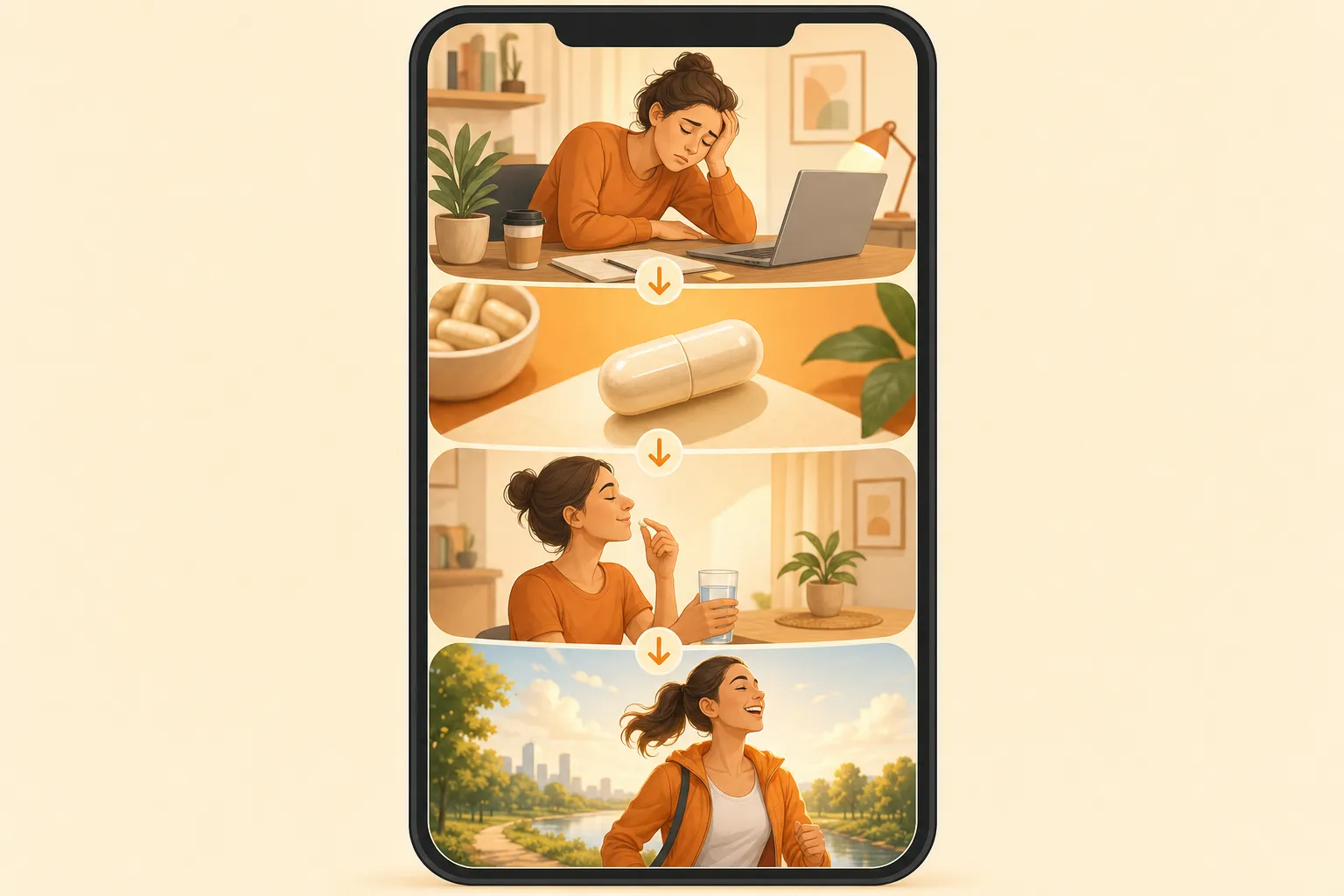
- Outcome hook — 0–2s. The identity or routine problem, not the ingredient: "3pm used to be my crash hour", "I built my morning routine around one jar", "The protein that doesn't wreck my stomach". Outcome-first hooks outperform ingredient-first opens in this category — but the outcome must be framed as a felt experience, not a disease claim.
- Ingredient and label reveal — 2–10s. Show the jar, the scoop, the capsule texture, the ingredient story. This is the trust section: real dosages, real format, clean visuals. If you name an ingredient, be prepared to substantiate the benefit you attach to it.
- Routine — 10–20s. Supplements sell on habit, not on pills. The routine shot — scoop in the shaker, capsule next to the coffee, greens in the morning glass — does the conversion work. This section can carry the whole ad without a single claim.
- Proof and CTA — last 5s. One social-proof beat: a real review quote, a customer count, a "98% would repurchase" style survey result (with the survey behind it). Then the ask. Keep the end-card text out of the bottom third, where platform overlays and safe zones live.
Per-niche hook patterns
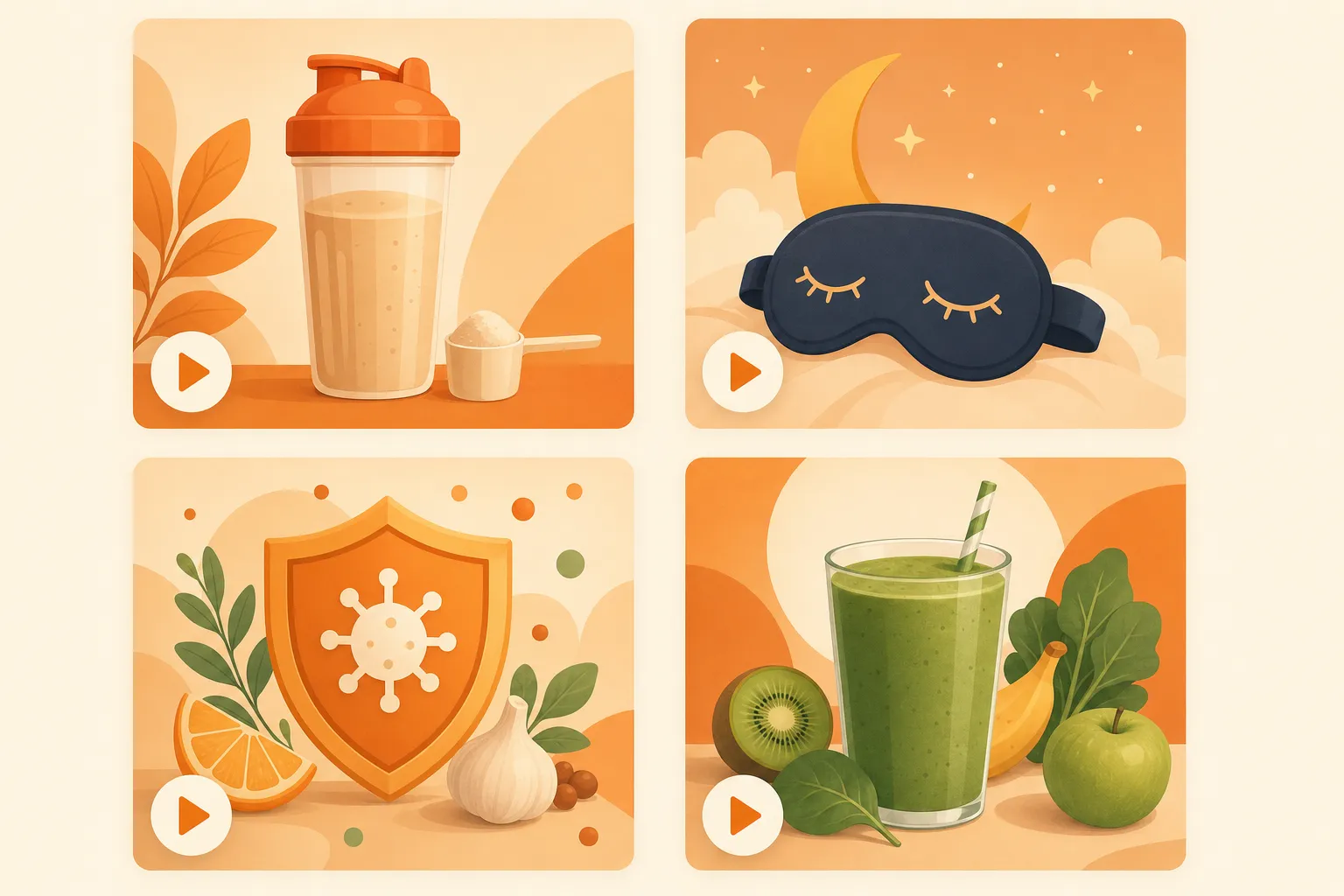
The same compliant pipeline produces different winners per supplement sub-category. These patterns hold up across Meta, TikTok, and Google inventory:
Protein and fitness
Hook: routine or recovery ("The shake that made my post-workout routine stick", "Macros without the chalky aftertaste"). Claims stay in structure/function territory: "supports muscle recovery after exercise", "supports lean muscle mass when combined with resistance training". Avoid "builds muscle", "burns fat", and any physique-transformation framing that crosses into weight-loss claim territory — that triggers the 18+ and healthy-lifestyle requirements even on otherwise clean creative.
Sleep and relaxation
Hook: the evening ritual ("My wind-down starts with this", "The last thing I take before the lights go out"). Allowed: "supports healthy sleep", "promotes relaxation", "helps you unwind as part of a wind-down routine". Banned: "cures insomnia", "puts you to sleep", "replaces your sleep medication". This niche is heavily reviewed — sleep is a body function, and anything that sounds like treatment gets flagged. Never show the product as a substitute for medical care.
Immunity
Hook: seasonal ("The cold-season shelf staple", "My immune support routine before travel season"). Allowed: "supports immune health", "supports the body's natural defenses", "contains vitamin C and zinc for immune support". Banned: "prevents colds", "fights flu", "kills viruses", "boosts immunity against COVID". The "boosts" verb is dangerous — it implies a measurable immune effect that requires RCT-level substantiation.
Greens and daily nutrition
Hook: the habit gap ("Getting 5 servings of vegetables is a full-time job", "The greens I actually finish the jar of"). This niche is the closest to food advertising: "provides nutrients", "supports daily nutrition", "a convenient source of phytonutrients" — all safe. The trap is the transition from nutrition to health outcome: "detoxifies", "cleanses", "flushes toxins" are disease-adjacent claims that get accounts banned on both Meta and TikTok.
Collagen and beauty-from-within
Hook: the routine upgrade ("The morning scoop that goes in my coffee", "Skin, hair, and nail support in one jar"). Allowed: "supports skin elasticity", "supports hair and nail health", "supports joint comfort". Banned: "reduces wrinkles", "grows hair", "treats brittle nails" — this is where the supplement compliance framework and the beauty cosmetic-drug framework collide, and the stricter reading wins on both platforms.
Weight management
The most restricted sub-niche in supplements. Meta requires 18+ targeting; TikTok requires 18+ targeting and healthy-lifestyle framing; TikTok Shop bans weight-loss products outright, including fat burners, appetite suppressants, and detox teas. Allowed language: "supports weight management as part of a balanced diet and exercise program", "supports metabolism". Anything promising weight loss as a product effect — before/after body imagery, "lose X pounds", "melts fat" — is prohibited territory. If you can't run the claim cleanly, run a different product angle.
Workflow: building a compliant supplement library
| Step | What to do | Why |
|---|---|---|
| 1. Claim audit before script | Write every claim as a sentence; classify each as structure/function or disease territory | Catches "lowers cholesterol" before it costs a creative |
| 2. One script per hook angle | Routine, outcome, ingredient, lifestyle — 4 angles per product | Platforms need variety; supplement hook fatigue is real |
| 3. Captions burned in | Hook + claim + CTA on screen in every cut | Sound-off placements dominate wellness content |
| 4. 18+ targeting set | Verify age targeting on every supplement ad set before launch | Meta and TikTok both require it as policy, not best practice |
| 5. Disclaimer policy | Labeling disclaimer on pack shots where shown; never rely on it to fix a bad claim | DSHEA disclaimer doesn't cure deceptive ads |
| 6. Refresh every 2–3 weeks | New hooks, new avatars, new angles on the same product | Stale creative plateaus; the auction rewards fresh assets |
Cost math: AI pipeline vs UGC creator vs in-house
The budget question for a supplement video library (say, 12 assets — 3 hooks × 2 products × 2 orientations — refreshed monthly):
| Channel | Cost per creative | Turnaround | 12-asset library |
|---|---|---|---|
| UGC creator (mid-tier) | $400–$800 | 7–14 days | $4,800–$9,600 |
| In-house studio shoot | $1,500–$5,000 | 2–4 weeks | $18k–$60k |
| Agency-managed | $1,000–$2,500 | 4–6 weeks | $12k–$30k |
| AI pipeline (Prizmad) | ≈$7–13 per finished ad | under 10 min | ≈$85–156, same day |
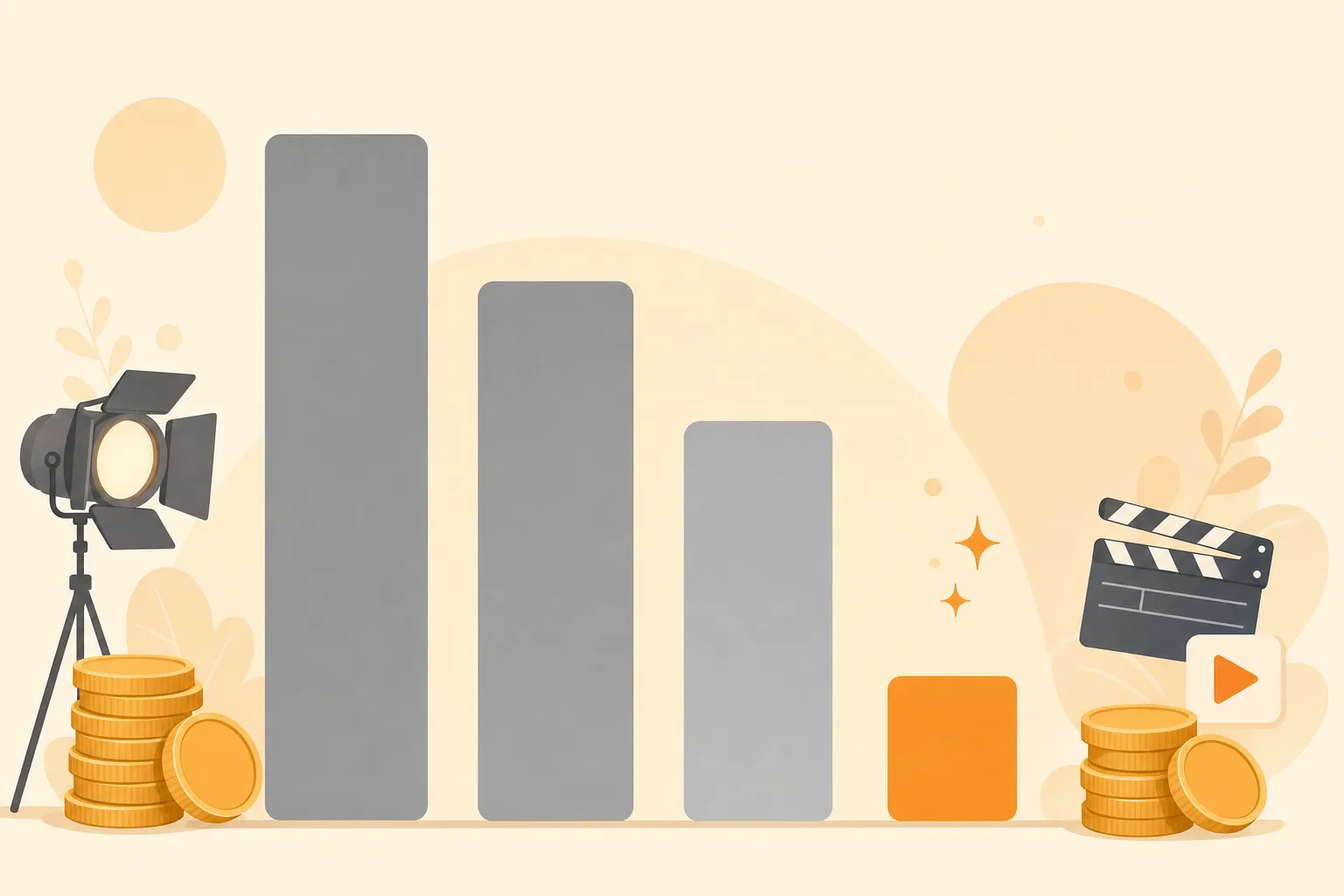
The AI line is a conservative estimate based on current plan pricing: Launch $39/mo for 3,000 tokens (roughly 3 finished avatar ads), Starter $99/mo for 8,000 tokens, Pro $249/mo for 35,000 tokens, per Prizmad pricing. For supplements specifically, volume is a compliance asset: generate 12 scripts, run the claim audit, and ship only the creatives that survive — discarding a risky frame costs a render, not a production cycle. The bottleneck becomes claim-safe script variety, which is exactly where a compliant pipeline should spend its effort.
Compliance: the playbook within the playbook
FTC: the substantiation spine
- Competent and reliable scientific evidence is the bar. The FTC defines it as tests, analyses, research, or studies conducted and evaluated objectively by experts in the relevant field, generally accepted as yielding accurate and reliable results — and for health benefits, that means randomized, controlled human clinical testing in practice. Animal studies, in vitro work, and testimonials don't substitute.
- The research must match the product. The study's formulation, dosage, and route of administration must match what you're advertising. A study on a different extract or a different dose doesn't substantiate your claim — the FTC has challenged exactly this mismatch repeatedly.
- Vague qualifiers don't qualify. "May help", "promising", "preliminary", "supports" — if the net impression is a stronger promise, the qualifier doesn't save the ad. The FTC reads the whole ad, not the single compliant sentence.
- Testimonials and endorsers are your claims. You are liable for what creators and influencers say about your product as if you said it yourself. A creator's "this cured my insomnia" is your disease claim. And "results not typical" does not cure a deceptive testimonial — the FTC requires a clear, conspicuous disclosure of the results a typical consumer can actually expect.
FDA: the DSHEA lane
- Structure/function claims describe how a nutrient affects normal structure or function; they're allowed for supplements with substantiation and the two-part labeling disclaimer: "This statement has not been evaluated by the Food and Drug Administration. This product is not intended to diagnose, treat, cure, or prevent any disease."
- Disease claims — treat, cure, prevent, diagnose — are not available to supplements at all. If your video's language implies disease treatment, no disclaimer fixes it.
- The FTC has said the DSHEA disclaimer isn't required in advertising and won't cure an otherwise deceptive ad. Treat the disclaimer as labeling hygiene, not as an ad-claims insurance policy.
Meta: Health and Wellness policy
- Dietary and health supplement ads must target 18+ audiences.
- Ads can't promote weight-loss or weight-gain products with close-up body imagery (pinching fat) or claims that results come solely from wearable products.
- Before/after transformation imagery for cosmetic procedures and products is not allowed; weight-loss transformation imagery is restricted.
- Repeat policy violations escalate from rejected creatives to restricted ad accounts — for supplement brands, a restriction is often effectively a channel shutdown.
TikTok: Weight Management and healthcare policies
- Weight-loss or muscle-gain claims must target 18+ audiences and must be framed within the promotion of a healthy lifestyle.
- Weight-loss surgery and procedures are not allowed in ads.
- TikTok Shop commerce rules go further: weight-loss/muscle-gain products and GLP-1 promotions are not allowed in commerce content at all.
- Healthcare and pharmaceutical-adjacent claims — treatment, prevention, cure — are reviewed under the Healthcare and Pharmaceuticals policy and are not allowed for supplements.
AI-generated supplement ads: no compliance holiday
- AI disclosure applies: Meta's AI-generated content label, TikTok's AI-generated content disclosure, Google's synthetic-content label. Compliance requirements don't change because the avatar is synthetic.
- Don't generate avatars that look like real identifiable people, doctors with credentials you can't verify, or "expert" characters implying medical authority — implying clinical endorsement you don't have is a deception risk, not just a policy risk.
- Everything on screen counts: burned-in captions, voiceover, on-pack copy shown in the video, and the landing page. A compliant video pointing to a non-compliant landing page is still a violation.
Allowed vs banned phrasing cheat sheet
| Allowed (structure/function, with substantiation) | Banned (disease claim or policy violation) |
|---|---|
| Supports immune health | Prevents colds / fights flu / boosts immunity against COVID |
| Supports healthy sleep | Cures insomnia / puts you to sleep |
| Supports joint comfort | Treats arthritis / relieves joint pain |
| Supports muscle recovery after exercise | Builds muscle / burns fat |
| Supports weight management as part of diet and exercise | Lose X pounds / melts fat / appetite suppressant |
| Supports metabolism | Lowers cholesterol / reduces blood pressure |
| Supports skin elasticity | Reduces wrinkles / grows hair |
| Maintains blood sugar already in normal range | Treats diabetes / lowers blood sugar |
| Supports the body's natural defenses | Detoxifies / cleanses / flushes toxins |
Frequently asked questions
What is Prizmad?
Prizmad is an AI ad agent for ecommerce brands. Paste a product link or describe your product in a chat, and the agent — trained on 60M+ ad creatives — writes the hooks and script, casts an AI actor and voice, and delivers ready-to-post video ads for TikTok, Reels and Shorts in about 5 minutes.
What are AI UGC ads?
AI UGC ads (AI-generated user-generated content ads) are video advertisements that use AI avatars, synthetic voiceovers, and automated editing to replicate the authentic, creator-style content traditionally filmed by real influencers or users. Prizmad generates AI UGC video ads from any product URL in minutes — at a fraction of the cost of hiring human UGC creators.
How long does it take to generate a video?
Most videos are ready within 5 minutes. Complex ads with custom avatars may take up to 10 minutes. You'll receive a notification when your video is ready.
Do I need video editing experience?
Not at all. You just chat: paste a product link, say what you want, and the agent handles the script, actor, voice and editing. Want a change? Ask in plain words.
Do I need a product link to get started?
No. A link is the fastest start — paste a page from Shopify, Amazon, Etsy or any store and the agent reads it. Or just describe your product in the chat.
Can I edit the AI-generated script?
Yes. The agent shows you the hooks and script before anything renders — edit any line yourself or ask it to ("make the hook punchier", "shorter CTA").
What platforms can I publish to?
Export videos ready for TikTok, Instagram Reels, Facebook Ads, YouTube Shorts, Shopify, and Amazon. All standard formats are included: 9:16 (vertical), 1:1 (square feed), and 16:9 (landscape) — all in Full HD 1080p.
How does AI UGC compare to hiring human UGC creators?
Traditional UGC creators charge $500–$2,000 per video and take 1–3 weeks to deliver. AI UGC ads from Prizmad cost approximately $7–13 per video (depending on your plan), generate in about 5 minutes, and can be produced in unlimited variations for A/B testing — in 15 languages from a single product link.
Do I own commercial rights to my AI-generated ads?
Yes. You own full commercial rights to every video ad you generate with Prizmad. Use them on any advertising platform, in any market, for as long as you want — no additional licensing fees.
Is it legal to run AI-generated video ads on TikTok, Meta, and Google?
Yes. AI-generated video ads are permitted on major ad platforms including Meta (Facebook and Instagram), TikTok, Google, and YouTube, provided they comply with each platform's advertising policies and any applicable AI-content disclosure requirements. You own full commercial rights to every video ad generated with Prizmad and can run them on any advertising platform without additional licensing fees.
How do tokens work?
Chatting with the agent is free — tokens are spent only on what it generates, like videos, images and voiceovers. A finished video ad with an AI avatar costs around 1,000 tokens; simpler videos cost far less. Launch includes 3,000 tokens, Starter 8,000 and Pro 35,000. Plan tokens refresh each billing cycle; top-up tokens never expire.
Can I cancel my subscription?
Yes, you can cancel anytime from your account settings. You'll keep access until the end of your billing period. No questions asked.
Ready to build a compliant supplement library in an afternoon? Paste your product URL into the Prizmad generator, generate 9:16, 4:5, and 1:1 masters from your product page, run the claim audit from this playbook, and ship the survivors to Meta, TikTok, and Google the same day.