
Beauty & Skincare Video Ads: The 2026 Compliance Playbook
Beauty and skincare video ads in 2026: verified Meta/TikTok specs, FTC-safe claims, the FDA cosmetic-vs-drug boundary, and compliant hook patterns.
On this page
Beauty is the vertical where ad compliance is most likely to cost you your account — not because the rules are secret, but because the product category sits exactly on the boundary between two regulators with different vocabularies. The FTC has settled or adjudicated more than 200 cases involving false or misleading advertising claims about health-related products since 1998, and its Health Products Compliance Guidance is explicit that the same principles apply to beauty and cosmetics marketing as to supplements: every claim must be truthful, not misleading, and substantiated before you run it.
The platform layer adds its own wall. Meta's Health and Wellness advertising policy restricts cosmetic, weight-loss, and supplement ads to 18+ audiences and bans before/after transformation depictions for general cosmetic products, procedures, and surgeries. TikTok requires weight-management claims to target 18+ and to promote a healthy lifestyle. Meanwhile, FDA law draws the line between a cosmetic and a drug at the words you use — and the same AI-generated creative that scales beautifully will get flagged exactly as fast as a human-shot spot.
This playbook covers the verified 2026 specs for Meta, TikTok, and Google placements, the cosmetic-versus-drug claim boundary with concrete allowed and banned phrasing, FTC-safe before/after handling, per-niche hook patterns, and the cost math of building a compliant beauty video library with an AI pipeline.
Why beauty ads get flagged: the cosmetic-drug boundary
The single most important regulatory fact for beauty advertisers: under the FD&C Act, a product is a cosmetic if it is intended to cleanse, beautify, promote attractiveness, or alter appearance — and a drug if it is intended to treat or prevent disease, or to affect the structure or function of the body. The same product can sit on either side of the line depending on how you talk about it.
Practical translation for video ads:
- Cosmetic territory (safe with substantiation): "improves the appearance of fine lines", "hydrates for 24 hours", "evens skin tone", "adds shine", "softens", "refreshes".
- Drug territory (do not touch without FDA-regulated drug status): "reduces wrinkles", "treats acne", "prevents aging", "kills bacteria", "reduces inflammation", "stimulates collagen production", "treats eczema".
The line moves with the claim, not with the product. "Reduces the appearance of fine lines" is a cosmetic claim; "reduces fine lines" drifts toward drug territory; "removes wrinkles" is a drug claim. Platform reviewers and FTC investigators both read the words on the screen, including burned-in captions and voiceover — an AI avatar saying "this serum treats your acne" is the same violation as a human saying it.
A second boundary matters just as much for beauty: the FTC's substantiation standard. Health-related claims — and beauty claims that touch skin health, hair health, or body function — require competent and reliable scientific evidence, which in practice means randomized, controlled human clinical testing. A claim like "clinically proven to reduce fine lines in 14 days" requires the study to exist, to match the product's dosage and formulation, and to be representative of what the ad promises. "Dermatologist recommended" requires an actual recommendation you can document. "Clean", "natural", and "chemical-free" are marketing adjectives, not claims, but they still need to be true in the way consumers reasonably understand them.
The 2026 spec sheet for beauty video ads
Verified against platform help centers on the day this guide was written. One 9:16 master covers most placements; crop to 4:5 for Meta Feed and 16:9 for in-stream.
| Platform / placement | Aspect ratio | Resolution | Duration | Notes |
|---|---|---|---|---|
| Meta Feed | 4:5 or 9:16 | 1080×1350 or 1080×1920 | 15–30s recommended | MP4/H.264; sound-off placements make burned-in captions non-negotiable |
| Meta Reels / Stories | 9:16 | 1080×1920 | 15–30s recommended | Vertical native; keep safe zones at top and bottom for UI overlays |
| Meta In-stream | 16:9 | 1920×1080 | 15s non-skippable sweet spot | Landscape only |
| TikTok In-Feed | 9:16 (recommended), 16:9, 1:1 | 9:16 ≥540×960 | Up to 10 min; 15–60s typical | File size ≤500 MB; 9–15s is the engagement sweet spot per third-party benchmarks |
| YouTube Shorts | 9:16 | 1080×1920 | ≤60s | Non-skippable; the hook lives in the first 2 seconds |
| YouTube In-stream | 16:9 | 1920×1080 | 15–20s action, 6s bumpers | Skippable at 5s |
| Google Performance Max | 16:9, 1:1, 9:16 | 1080p | 10s+ per asset; 15–30s recommended | One video per orientation; vertical 10–60s for Shorts eligibility |
| Google Demand Gen | 1:1, 4:5, 9:16 | 1080×1080 / 1080×1350 / 1080×1920 | Min 5s; 15–30s recommended | Headline ≤40 chars, description ≤90 |
Beauty creative over-indexes on sound-off placements — Reels, Stories, and Shorts autoplay without audio more than almost any other category. Burned-in captions for the hook and the claim are not optional; a claim that exists only in voiceover is a claim half your audience never heard and reviewers flag mismatches between what's said and what's shown.
Anatomy of a compliant beauty ad
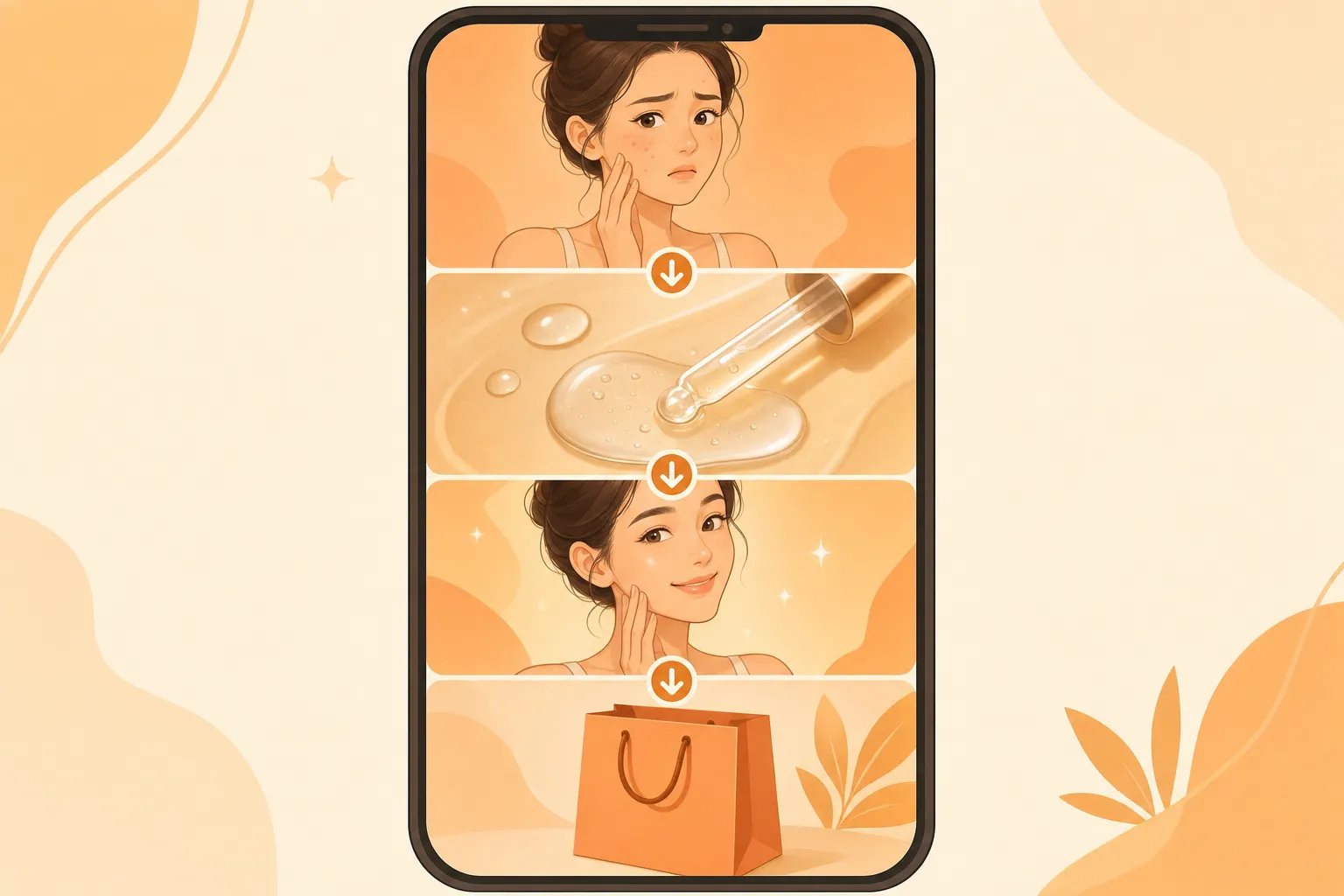
- Problem hook — 0–2s. The concern, not the bottle: "Why your skin still looks tired by 3pm", "This is what 6 months of breakouts does to a routine". Problem-first hooks outperform product-first opens in beauty across feed placements — but frame the problem as a concern, never as a medical condition ("acne-prone skin" is fine as a descriptor; "acne treatment" is a drug claim).
- Texture and application — 2–10s. Beauty is a sensory category. Close-ups of texture, absorption, and the application ritual (serum dropper, pump, pat-in motion) do the selling that words can't. This is also the safest section of the ad: demonstrating how the product feels carries no claim risk at all.
- Result reveal — 10–20s. Show the outcome, not the miracle. "Day 14 texture" with honest framing, a routine shot, a finished makeup look. If you show a before/after, it must not imply treatment and must be representative — see the compliance section, because this is where beauty ads die.
- Proof and CTA — last 5s. One social-proof beat — a star rating, a real review quote, a customer count — then the ask. Meta and TikTok overlay their own CTA buttons, so the verbal ask and the on-screen button should agree. Keep the end-card text out of the bottom third, where overlays and safe zones live.
Per-niche hook patterns
The same compliant pipeline produces different winners per beauty sub-category. These are patterns that hold up across Meta, TikTok, and Google inventory:
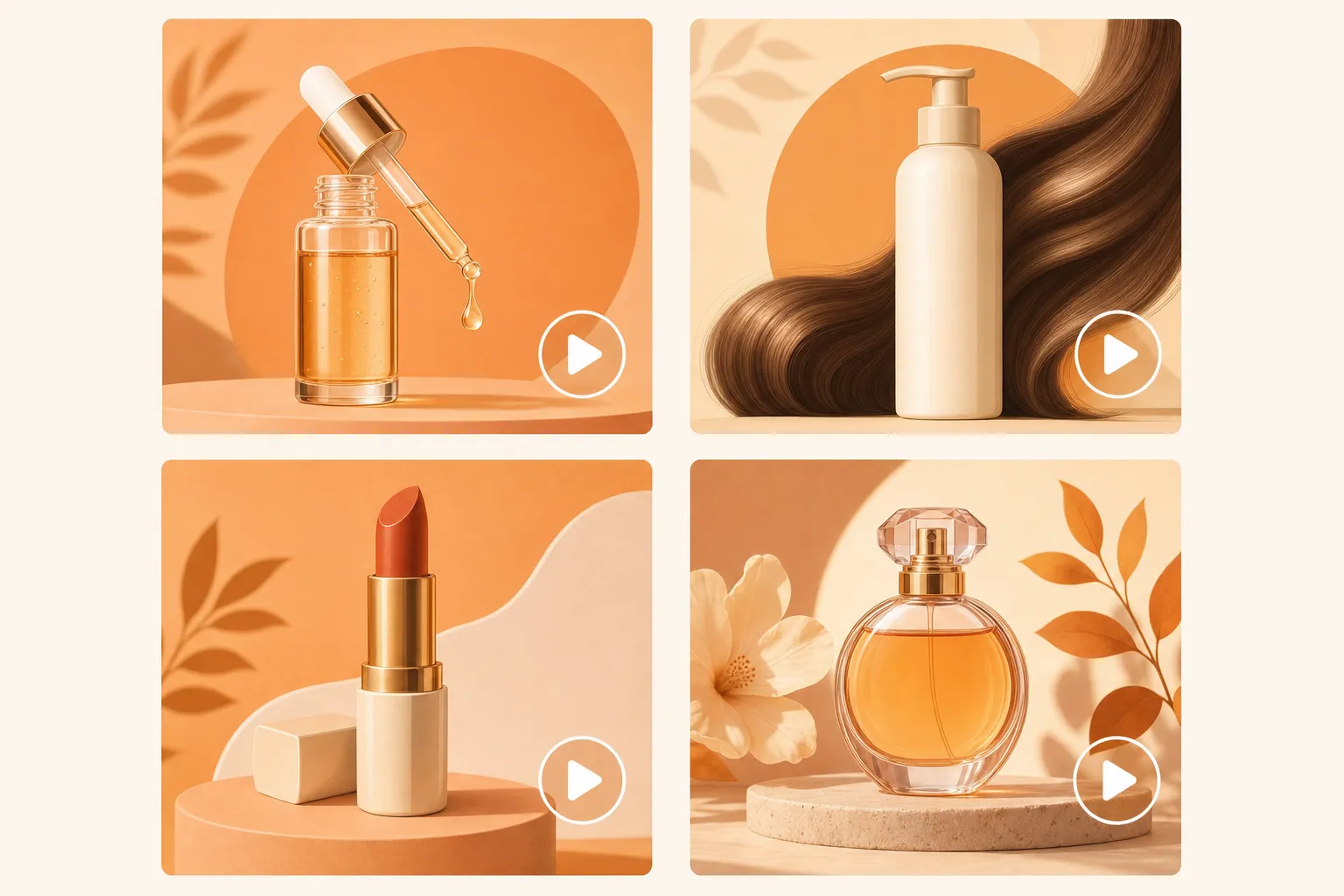
Skincare and serums
Hook: problem-first ("Why your skin still looks tired by 3pm"). First frame is the texture or the concern; the bottle arrives at the reveal. Claim language stays cosmetic: "hydrates", "supports the skin barrier", "improves the appearance of". The category's biggest compliance trap is the urge to promise a cure ("clears breakouts in 3 days") — that turns a cosmetic into a drug claim in one sentence.
Acne and blemish
Highest-risk sub-niche in beauty. Any claim of treatment ("treats acne", "heals breakouts", "reduces inflammation") is a drug claim under FDA rules and a platform violation under Meta's health policies. Compliant alternatives: "formulated for acne-prone skin", "non-comedogenic", "gentle for reactive skin". The hook can be the frustration ("I tried every acid on the shelf") as long as the resolution is routine-based, not cure-based.
Hair care
Hook: transformation ("The 2-minute routine that changed my wash day"). Shine, volume, softness, and scalp feel are cosmetic territory; regrowth, "stops shedding", and "treats thinning" are drug claims. Be careful with density language — "adds body" is safe, "regrows hair" is not. Texture shots (lather, slip, shine) carry most of the weight here.
Makeup and color
Hook: before/after application (one side of the face bare, one done) or shade-range inclusivity ("finally a foundation for my undertone"). The reveal is the payoff. Claim risk is lowest in this niche — stay out of "long-lasting 24h" territory unless you have the wear-test data, and avoid skincare-benefit claims for makeup ("foundation that treats your skin") unless the product actually qualifies as a cosmetic-plus.
Fragrance
Hook: mood and identity ("The scent people ask me about", "First spray of the season"). Fragrance sells on association — time, place, feeling — not on claims. Keep notes and longevity claims honest ("lasts through the workday" needs the test behind it). Zero health claims, obviously: "calming", "energizing" as scent descriptors are fine; "relieves stress" is not.
Anti-aging
The highest-value and highest-risk beauty niche. Cosmetic-safe: "softens the look of fine lines", "supports elasticity", "hydrates for visibly plumper-looking skin". Banned: "reduces wrinkles", "prevents aging", "stimulates collagen", "reverses aging". Every claim in this niche needs the strongest substantiation — if you cite a clinical study, it must match your product's formulation and dosage.
Workflow: building a compliant beauty library
| Step | What to do | Why |
|---|---|---|
| 1. Claim audit before script | Write every claim in the ad as a sentence; classify each as cosmetic or drug territory | Catches "reduces wrinkles" before it costs a creative |
| 2. One script per hook angle | Problem-first, routine, texture, transformation — 4 angles per product | Feed platforms need variety; beauty rewards hook diversity |
| 3. Captions burned in | Hook + claim + CTA on screen in every cut | Sound-off placements dominate beauty |
| 4. Before/after policy | Same lighting, same angle, same expression; representative results; time-to-result disclosed | Meta restricts transformation imagery; FTC requires representative results |
| 5. Review loop | One pass for claims, one for visuals, one for landing-page match | Landing page must support every claim the video makes |
| 6. Refresh every 2–3 weeks | New hooks, new avatars, new angles on the same product | Stale creative plateaus; the auction rewards fresh assets |
Cost math: AI pipeline vs UGC creator vs in-house
The budget question for a beauty video library (say, 12 assets — 3 hooks × 2 products × 2 orientations — refreshed monthly):
| Channel | Cost per creative | Turnaround | 12-asset library |
|---|---|---|---|
| UGC creator (mid-tier) | $400–$800 | 7–14 days | $4,800–$9,600 |
| In-house studio shoot | $1,500–$5,000 | 2–4 weeks | $18k–$60k |
| Agency-managed | $1,000–$2,500 | 4–6 weeks | $12k–$30k |
| AI pipeline (Prizmad) | ≈$7–13 per finished ad | under 10 min | ≈$85–156, same day |
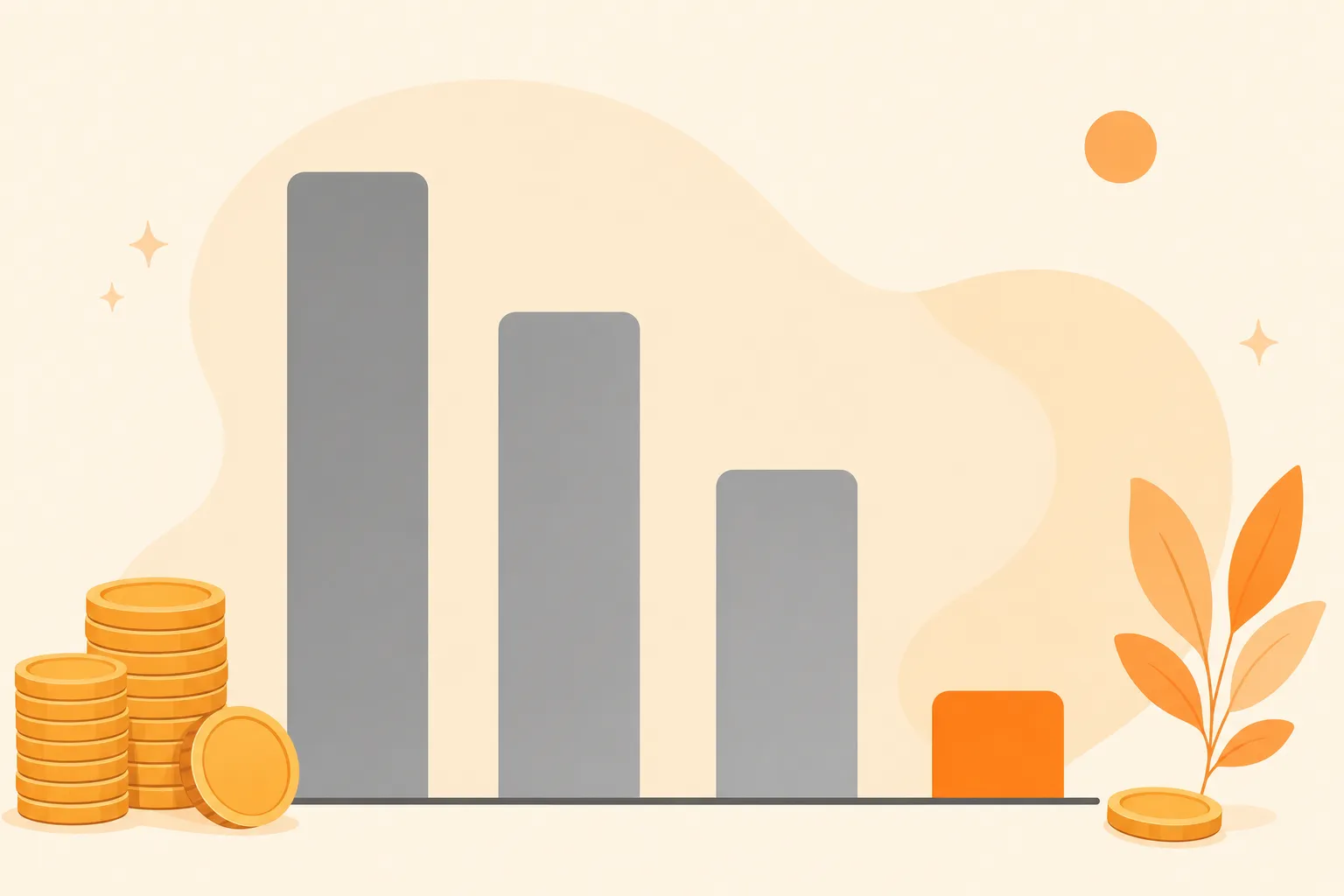
The AI line is a conservative estimate based on current plan pricing: Launch $39/mo for 3,000 tokens (roughly 3 finished avatar ads), Starter $99/mo for 8,000 tokens, Pro $249/mo for 35,000 tokens, per Prizmad pricing. The strategic point for beauty specifically: compliance review is a creative-selection problem, and volume is what lets you discard the risky frames. An account that generates 12 fresh, claim-audited videos a month and ships the 4 that survive review consistently out-tests an account that runs one expensive shoot for a quarter.
Seasonality moves the cadence rather than the math: gifting and promo windows are when the same library has to be refreshed hardest, and the calendar that most beauty brands plan backwards from is in the Black Friday video ads guide.
Compliance: the playbook within the playbook
This is the section most beauty guides skip, and the one that decides whether your account survives the year.
FTC: claims, substantiation, and the "results not typical" trap
- Substantiate before you publish. Under the FTC Act, every objective product claim — express or implied — must have adequate substantiation before the ad runs. For health-adjacent beauty claims, that means competent and reliable scientific evidence: in practice, human clinical testing, not lab anecdotes or customer emails.
- "Results not typical" does not cure deception. The FTC is explicit: testimonials that report results more dramatic than users can generally expect are likely deceptive, and disclaimers like "results not typical" don't fix that. A before/after testimonial must be accompanied by a clear and conspicuous disclosure of the results a typical consumer can actually expect — a vague fine-print asterisk is the classic failed pattern.
- You are liable for endorsers. Influencer clips, UGC creator testimonials, and expert endorsements are advertising. You cannot make a claim through a creator's mouth that you couldn't substantiate if you said it directly.
- Vague qualifiers don't qualify. "May help", "promising", "preliminary", "supports" — if the rest of the ad conveys a stronger promise, the qualifier doesn't save it. The FTC reads the net impression, not the fine print.
FDA: the cosmetic-drug line in practice
- The same product is a cosmetic or a drug depending on the intended use you communicate. "Improves the appearance of fine lines" — cosmetic. "Reduces wrinkles" — drug. "Hydrates" — cosmetic. "Treats dry skin conditions" — drug.
- If a claim pushes the product into drug territory, the product itself needs to meet FDA drug requirements — a marketing fix is not available. When in doubt, downgrade the claim.
- MoCRA (the Modernization of Cosmetics Regulation Act) modernized FDA oversight of cosmetics: facility registration, product listing, and adverse-event reporting now apply to most cosmetics sold in the US. It doesn't change ad-claim law directly, but it raises the stakes of sloppy claims because FDA now has a clearer enforcement path to the same products you advertise.
Meta: Health and Wellness policy
- Ads for weight-loss/gain products, cosmetic procedures, and dietary or health supplements must target 18+ audiences.
- Meta does not allow general cosmetic products, procedures, or surgeries depicted as before/after transformations.
- Ads can show people using the product and its impact — and must clearly indicate the time taken to achieve noticeable results.
- Before/after that implies treatment, or close-up body imagery that reinforces insecurity, gets rejected at review and can restrict the ad account on repeat offenses.
TikTok: health claims and 18+ targeting
- Weight-management and body-transformation claims must target 18+ and must frame results within a healthy-lifestyle context.
- Cosmetic procedures and health-claim content is reviewed under TikTok's Healthcare and Pharmaceuticals policy; claims of treatment or cure are not allowed.
- For TikTok Shop sellers, weight-loss/muscle-gain products and GLP-1 promotions are not allowed in commerce content — separate from paid ads, but same brand risk.
AI-generated beauty ads: no compliance holiday
- AI disclosure applies: Meta's AI-generated content label, TikTok's AI-generated content disclosure, Google's synthetic-content label. An AI avatar saying a claim doesn't change the claim's substantiation burden — it changes who reviewers scrutinize first.
- Don't generate avatars that look like real identifiable people, competitors' founders, or your own customers. This is a right-of-publicity issue in the US and EU, and a platform-policy issue everywhere.
- The claim rules apply to everything on screen: burned-in captions, voiceover, on-pack copy shown in the video, and the landing page. A compliant video pointing to a non-compliant landing page is still a violation.
Allowed vs banned phrasing cheat sheet
| Allowed (with substantiation) | Banned (drug territory or policy violation) |
|---|---|
| Improves the appearance of fine lines | Reduces wrinkles / removes wrinkles |
| Hydrates for 24 hours | Treats dry skin / cures eczema |
| Formulated for acne-prone skin | Treats acne / clears breakouts |
| Supports the skin barrier | Repairs the skin barrier / restores collagen |
| Adds volume and shine | Regrows hair / stops hair loss |
| Softens the look of dark spots | Lightens hyperpigmentation / fades melasma |
| Before/after with representative results and time-to-result | Before/after implying treatment or guaranteed transformation |
Frequently asked questions
What is Prizmad?
Prizmad is an AI ad agent for ecommerce brands. Paste a product link or describe your product in a chat, and the agent — trained on 60M+ ad creatives — writes the hooks and script, casts an AI actor and voice, and delivers ready-to-post video ads for TikTok, Reels and Shorts in about 5 minutes.
What are AI UGC ads?
AI UGC ads (AI-generated user-generated content ads) are video advertisements that use AI avatars, synthetic voiceovers, and automated editing to replicate the authentic, creator-style content traditionally filmed by real influencers or users. Prizmad generates AI UGC video ads from any product URL in minutes — at a fraction of the cost of hiring human UGC creators.
How long does it take to generate a video?
Most videos are ready within 5 minutes. Complex ads with custom avatars may take up to 10 minutes. You'll receive a notification when your video is ready.
Do I need video editing experience?
Not at all. You just chat: paste a product link, say what you want, and the agent handles the script, actor, voice and editing. Want a change? Ask in plain words.
Do I need a product link to get started?
No. A link is the fastest start — paste a page from Shopify, Amazon, Etsy or any store and the agent reads it. Or just describe your product in the chat.
Can I edit the AI-generated script?
Yes. The agent shows you the hooks and script before anything renders — edit any line yourself or ask it to ("make the hook punchier", "shorter CTA").
What platforms can I publish to?
Export videos ready for TikTok, Instagram Reels, Facebook Ads, YouTube Shorts, Shopify, and Amazon. All standard formats are included: 9:16 (vertical), 1:1 (square feed), and 16:9 (landscape) — all in Full HD 1080p.
How does AI UGC compare to hiring human UGC creators?
Traditional UGC creators charge $500–$2,000 per video and take 1–3 weeks to deliver. AI UGC ads from Prizmad cost approximately $7–13 per video (depending on your plan), generate in about 5 minutes, and can be produced in unlimited variations for A/B testing — in 15 languages from a single product link.
Do I own commercial rights to my AI-generated ads?
Yes. You own full commercial rights to every video ad you generate with Prizmad. Use them on any advertising platform, in any market, for as long as you want — no additional licensing fees.
Is it legal to run AI-generated video ads on TikTok, Meta, and Google?
Yes. AI-generated video ads are permitted on major ad platforms including Meta (Facebook and Instagram), TikTok, Google, and YouTube, provided they comply with each platform's advertising policies and any applicable AI-content disclosure requirements. You own full commercial rights to every video ad generated with Prizmad and can run them on any advertising platform without additional licensing fees.
How do tokens work?
Chatting with the agent is free — tokens are spent only on what it generates, like videos, images and voiceovers. A finished video ad with an AI avatar costs around 1,000 tokens; simpler videos cost far less. Launch includes 3,000 tokens, Starter 8,000 and Pro 35,000. Plan tokens refresh each billing cycle; top-up tokens never expire.
Can I cancel my subscription?
Yes, you can cancel anytime from your account settings. You'll keep access until the end of your billing period. No questions asked.
Ready to build a compliant beauty library in an afternoon? Paste your product URL into the Prizmad generator, generate 9:16, 4:5, and 1:1 masters from your product page, run the claim audit from this playbook, and ship the survivors to Meta, TikTok, and Google the same day.