
Black Friday Video Ads: The 2026 Playbook for Ecommerce
Black Friday and Cyber Monday 2026 video ads: the Q4 creative calendar, verified specs, compliant urgency hooks, and holiday creative cost math.
On this page
Black Friday 2026 is November 27, and Cyber Monday follows on November 30. If your holiday video creative isn't being built and tested right now, in August, you are already behind — not because the ads take months to produce, but because the learning takes months. The accounts that win Q4 are the ones that enter November with a tested creative library, not the ones that start producing spots in October and hope.
The Q4 auction is the most expensive and most competitive of the year. CPMs climb, every competitor runs urgency creative, and creative fatigue hits faster because audiences see the same holiday hooks everywhere. That is the structural problem this playbook solves: a calendar that tells you when to build, verified 2026 format specs for Meta, TikTok and Google, urgency hooks that convert without tripping compliance, per-niche creative patterns, and the cost math of a holiday library that survives six weeks of peak spend.
Why Q4 is a different advertising game
Three things change in November, and they change the creative math:
- Auction pressure. Holiday demand pushes CPMs up across Meta, TikTok and Google. When impressions get more expensive, the cost of a weak creative goes up with them — a 1.5% CTR creative at $30 CPM is a different business problem than the same creative at $12 CPM.
- Creative fatigue accelerates. Holiday hooks are the most recycled creative in ecommerce: countdown timers, "doorbuster", "up to 70% off". Audiences pattern-match them in under a second. The account that rotates fresh angles wins; the account that runs one "BIGGEST SALE EVER" spot for six weeks pays the auction's tax.
- The calendar compresses decision windows. Between Thanksgiving and Christmas there are roughly four shopping weekends plus Cyber Week. There is no time to "test and learn" in November — the test matrix has to exist before the peak, which is why the build phase belongs to August and September.
The Q4 creative calendar
| Window | What you do | Why |
|---|---|---|
| August–September | Build and test hooks on evergreen creative | You need CTR and CPA baselines before the auction inflates |
| Early October | Freeze winning hooks; produce holiday-specific variants | Holiday creative needs its own assets, not just new text overlays |
| Late October | Load asset libraries, check platform specs, soft-launch teaser creative | Platforms review and approve in advance; don't discover a policy flag on Nov 1 |
| Early November | Launch holiday campaigns with tested hooks; scale winners daily | First 1–2 weeks of November are still relatively affordable |
| Cyber Week (Nov 27–30) | BFCM-specific offers: flash timers, doorbusters, gift guides | Peak volume; creative that was tested in October now runs at scale |
| Mid-December | Last-chance creative: shipping deadlines, "still in time for Christmas" | Post-BFCM CPMs drop; late shoppers are high-intent |
The calendar rule that matters most: never launch untested creative into the peak. If a hook hasn't proven itself by November 1, it doesn't get a holiday budget — it gets a January test budget.
The 2026 spec sheet for holiday video ads
Verified against platform help centers on the day this guide was written. The good news: one 9:16 master covers most of the peak.
| Platform / placement | Aspect ratio | Resolution | Duration | Notes |
|---|---|---|---|---|
| Meta Feed | 4:5 or 9:16 | 1080×1350 or 1080×1920 | 15–30s recommended | MP4/H.264; third-party testing reports 9:16 video delivering roughly 7% higher CTR than 1:1 in feed |
| Meta Reels / Stories | 9:16 | 1080×1920 | 15–30s recommended | Vertical native; safe zones at top and bottom for UI overlays |
| Meta In-stream | 16:9 | 1920×1080 | 15s non-skippable sweet spot | Landscape only |
| TikTok In-Feed | 9:16 (recommended), 16:9, 1:1 | 9:16 ≥540×960 | Up to 10 min; 15–60s typical | File size ≤500 MB; 9–15s is the engagement sweet spot per third-party benchmarks |
| YouTube Shorts | 9:16 | 1080×1920 | ≤60s | Non-skippable; exit is a swipe, so the hook lives in the first 2 seconds |
| YouTube In-stream | 16:9 | 1920×1080 | 15–20s action, 6s bumpers | Skippable at 5s |
| Google Performance Max | 16:9, 1:1, 9:16 | 1080p | 10s+ per asset; 15–30s recommended | One video per orientation; vertical 10–60s for Shorts eligibility |
| Google Demand Gen | 1:1, 4:5, 9:16 | 1080×1080 / 1080×1350 / 1080×1920 | Min 5s; 15–30s recommended | Headline ≤40 chars, description ≤90 |
Produce a 9:16 master first, then crop to 4:5 for Meta Feed and 16:9 for in-stream. Going the other direction leaves dead space on Reels and Stories.
Urgency without lying: the Q4 compliance layer
Black Friday creative runs on urgency, and urgency is exactly where holiday accounts get flagged. The rules that matter:
- FTC: don't misrepresent limited availability. A countdown timer that resets every session, a "only 3 left" badge that never changes, or a "flash sale" that runs for a month is a deceptive-practice risk regardless of platform. The FTC's guidance on false urgency applies to advertising generally — make the scarcity real, or don't claim it.
- Sale dates must be truthful. "Ends tonight" means the offer ends tonight. If you extend the sale, the creative must not still claim it was ending when it didn't.
- Platform misrepresentation policies. Meta, TikTok and Google all police deceptive claims in ad copy and overlays. A countdown overlay that restarts is the fastest way to get a holiday account restricted — and a restriction in November is catastrophic.
- AI disclosure still applies. Holiday creative generated with AI avatars needs the same synthetic-content labels as any other AI ad: Google's synthetic content label, Meta's AI-generated content label, TikTok's AI-generated content disclosure. Compliance doesn't pause for the holidays.
- Health claims don't get a holiday pass. Skincare and supplements are the two categories where holiday urgency copy ("last chance to fix your skin") crosses into medical-claim territory. Keep the offer urgency, not the outcome urgency.
Anatomy of a converting BFCM ad
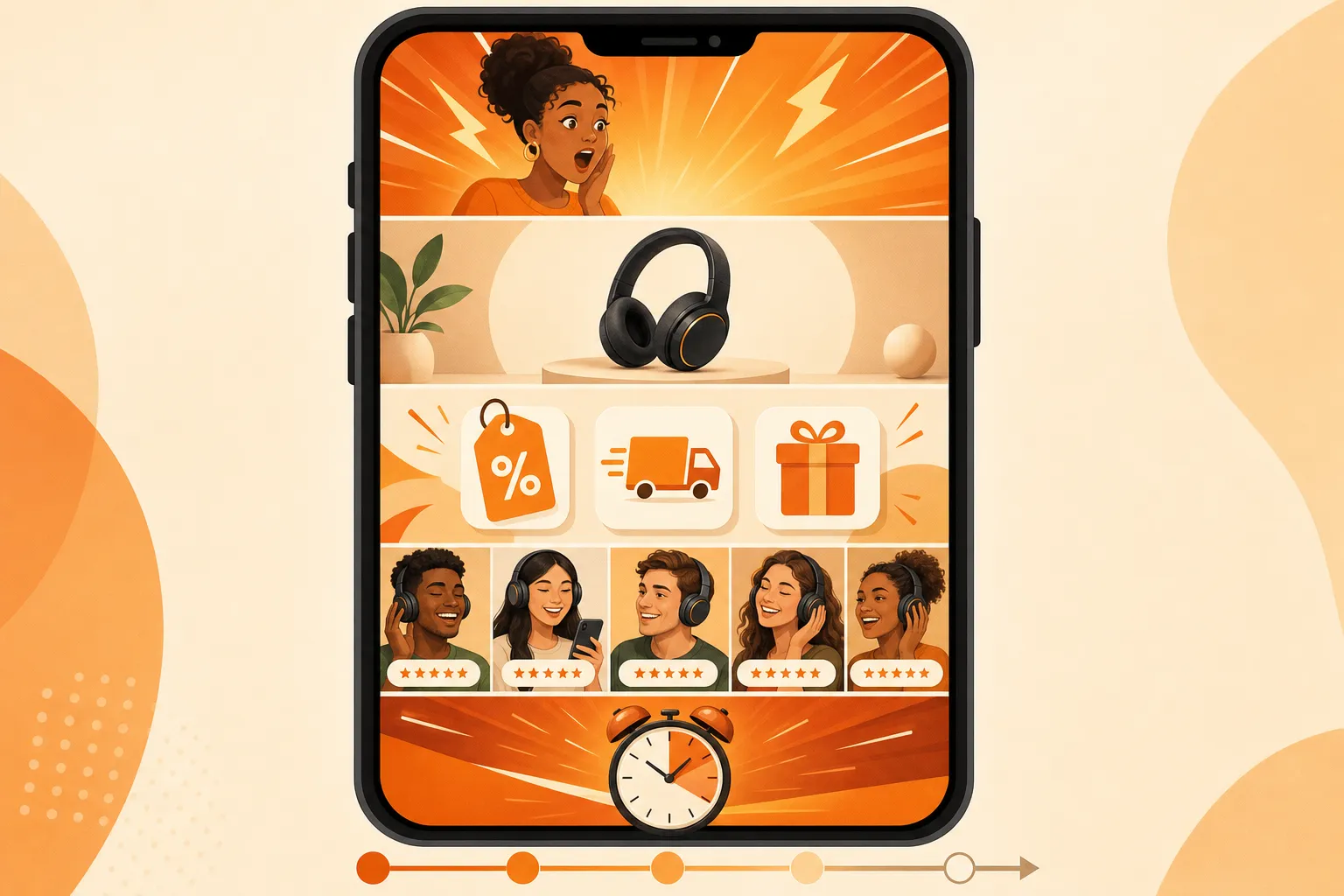
- Urgency hook — 0–2s. The holiday version of the pattern-interrupt: "Doorbuster ends at midnight", "This is the cheapest this set has ever been", "Cyber Monday price, today only". The offer itself is the hook — don't bury the discount behind a brand intro.
- Product reveal — 2–8s. Show the product with the deal framing: the bundle, the set, the gift-ready box. Holiday shoppers buy gifts, so show the product as a gift, not just a product.
- Offer stack — 8–15s. The discount, the free shipping threshold, the free gift with purchase, the bundle savings. One clear offer stack beats three confusing ones; Q4 shoppers compare offers fast.
- Proof — 15–20s. Review quotes, star ratings, "10,000+ ordered this week". Holiday social proof converts because gift buyers are anxious about choosing wrong.
- Countdown CTA — last 5s. The deadline, stated verbally and visually: "Sale ends tonight", "Shipping cut-off approaching". If you show a countdown, it must match the actual offer end.
Per-niche holiday playbooks

Fashion and apparel
Hook: deal-first ("The $128 coat that's $64 today"). Q4 fashion converts on the discount-to-quality ratio, so show the fabric, the fit, and the price together. Avatar tone: aspirational but approachable — "I'm wearing the size M". Compliance: keep "was/now" pricing honest; the reference price must be a real price the item sold at, not an inflated anchor.
Beauty and skincare
Hook: gift-frame ("The set that fixed my winter skin — and it's gift-ready"). Holiday beauty is a gift category, so the reveal should show the box, the ritual, the unboxing. Avatar tone: warm, testimonial-style. Compliance: no medical claims, no before/after implying treatment, and holiday "last chance" copy must not morph into outcome claims about the product's effects.
Home and decor
Hook: transformation + deadline ("Get the kitchen you keep seeing on your feed before the holidays"). Q4 home converts on aspirational living rooms and hosting anxiety. Show the result first, the product second. The "still in time for Christmas delivery" angle matters more here than in any other category — shipping deadlines are the real urgency.
Supplements and wellness
Hook: routine-first ("Your 30-day reset, started before the holiday season"). Q4 supplements skew toward pre-New-Year routines and gift sets. Avatar tone: calm, credible. Compliance is the strictest of any vertical: "supports" / "may help with" only, no treatment or prevention claims, and holiday urgency copy must not imply the product prevents holiday overindulgence or illness.
Toys and kids
Hook: panic-free ("The gift they asked for — still in stock, still at the doorbuster price"). Q4 toys is the most deadline-sensitive category: parents buy on stock fear and shipping cut-offs. Show the product in use, the box, and the age range. Compliance: honest stock claims — if a "low stock" badge is shown, it has to be true.
The pre-BFCM test matrix
The cheapest insurance for November is a disciplined August–October test matrix:
| Variable | Minimum to test | Kill rule |
|---|---|---|
| Hooks | 4 distinct hooks per top product | Kill any hook below 70% of median CTR after $15–20 spend |
| Product angles | 2 per product (hero feature + lifestyle use) | Keep the winner per hook |
| Formats | 9:16 master + 4:5 crop + 16:9 crop | If the master wins, the crops inherit |
| Offers | 2 offer framings (discount-first vs gift-first) | Tested in October, decided before November |
| Avatars | 2–3 distinct avatar personalities | Match the avatar tone to the niche, not to the founder |
The output of the matrix is a frozen creative library: for each product, 2–3 proven hooks × the winning avatar × all three aspect ratios. By November 1 you should have zero questions left about what to run — only budget allocation decisions.
Cost math: building a holiday creative library
A realistic Q4 library is 24–40 creatives (4 hooks × 3 products × 2 offer framings, plus crops). The production math:
| Channel | Cost per creative | Turnaround | 30-creative holiday library |
|---|---|---|---|
| UGC creator (mid-tier) | $400–$800 | 7–14 days | $12,000–$24,000 |
| In-house studio shoot | $1,500–$5,000 | 2–4 weeks | $45k–$150k |
| Agency-managed | $1,000–$2,500 | 4–6 weeks | $30k–$75k |
| AI pipeline (Prizmad) | ≈$7–13 per finished ad | under 10 min | ≈$215–390, same day |

The AI line is a conservative estimate based on current plan pricing (Launch $39/mo for 3,000 tokens, roughly 3 finished avatar ads; Starter $99/mo for 8,000 tokens; Pro $249/mo for 35,000 tokens, per Prizmad pricing). The strategic advantage is not just cost — it's the ability to refresh creative during the peak. When a doorbuster hook fatigues on November 29, a human pipeline cannot deliver a replacement before Cyber Monday ends. An AI pipeline can.
Frequently asked questions
What is Prizmad?
Prizmad is an AI ad agent for ecommerce brands. Paste a product link or describe your product in a chat, and the agent — trained on 60M+ ad creatives — writes the hooks and script, casts an AI actor and voice, and delivers ready-to-post video ads for TikTok, Reels and Shorts in about 5 minutes.
What are AI UGC ads?
AI UGC ads (AI-generated user-generated content ads) are video advertisements that use AI avatars, synthetic voiceovers, and automated editing to replicate the authentic, creator-style content traditionally filmed by real influencers or users. Prizmad generates AI UGC video ads from any product URL in minutes — at a fraction of the cost of hiring human UGC creators.
How long does it take to generate a video?
Most videos are ready within 5 minutes. Complex ads with custom avatars may take up to 10 minutes. You'll receive a notification when your video is ready.
Do I need video editing experience?
Not at all. You just chat: paste a product link, say what you want, and the agent handles the script, actor, voice and editing. Want a change? Ask in plain words.
Do I need a product link to get started?
No. A link is the fastest start — paste a page from Shopify, Amazon, Etsy or any store and the agent reads it. Or just describe your product in the chat.
Can I edit the AI-generated script?
Yes. The agent shows you the hooks and script before anything renders — edit any line yourself or ask it to ("make the hook punchier", "shorter CTA").
What platforms can I publish to?
Export videos ready for TikTok, Instagram Reels, Facebook Ads, YouTube Shorts, Shopify, and Amazon. All standard formats are included: 9:16 (vertical), 1:1 (square feed), and 16:9 (landscape) — all in Full HD 1080p.
How does AI UGC compare to hiring human UGC creators?
Traditional UGC creators charge $500–$2,000 per video and take 1–3 weeks to deliver. AI UGC ads from Prizmad cost approximately $7–13 per video (depending on your plan), generate in about 5 minutes, and can be produced in unlimited variations for A/B testing — in 15 languages from a single product link.
Do I own commercial rights to my AI-generated ads?
Yes. You own full commercial rights to every video ad you generate with Prizmad. Use them on any advertising platform, in any market, for as long as you want — no additional licensing fees.
Is it legal to run AI-generated video ads on TikTok, Meta, and Google?
Yes. AI-generated video ads are permitted on major ad platforms including Meta (Facebook and Instagram), TikTok, Google, and YouTube, provided they comply with each platform's advertising policies and any applicable AI-content disclosure requirements. You own full commercial rights to every video ad generated with Prizmad and can run them on any advertising platform without additional licensing fees.
How do tokens work?
Chatting with the agent is free — tokens are spent only on what it generates, like videos, images and voiceovers. A finished video ad with an AI avatar costs around 1,000 tokens; simpler videos cost far less. Launch includes 3,000 tokens, Starter 8,000 and Pro 35,000. Plan tokens refresh each billing cycle; top-up tokens never expire.
Can I cancel my subscription?
Yes, you can cancel anytime from your account settings. You'll keep access until the end of your billing period. No questions asked.
Start the Q4 clock now. Paste your product URL into the Prizmad generator and get a 9:16 holiday-ready mp4 in about five minutes — build the test matrix in August, freeze the winners in October, and hit November with a library instead of a hope.