
What Hollywood's AI Video Startup Means for Ad Creative
Katzenberg and ex-Sora head Bill Peebles are reportedly building an AI video startup for filmmakers. What that changes for ad creative — and what it does not.

On this page
The Information reported this week that Jeffrey Katzenberg — the DreamWorks co-founder who also co-founded Quibi — is teaming up with Bill Peebles, the former head of OpenAI's Sora app, and former Dropbox CFO Sujay Jaswa to build a new AI video company (The Information, Sept 9; picked up by The Verge, Sept 11). According to the report, the unnamed venture intends to train its own video models and win over filmmakers once it raises enough funding.
Read the caveats first, because they are the whole story for an advertiser: no company name, no announced funding round, no product, no pricing, no timeline. This is a report about where capital and talent are heading, not a tool you can buy — and it says more about the other lane of AI video than it does about yours.
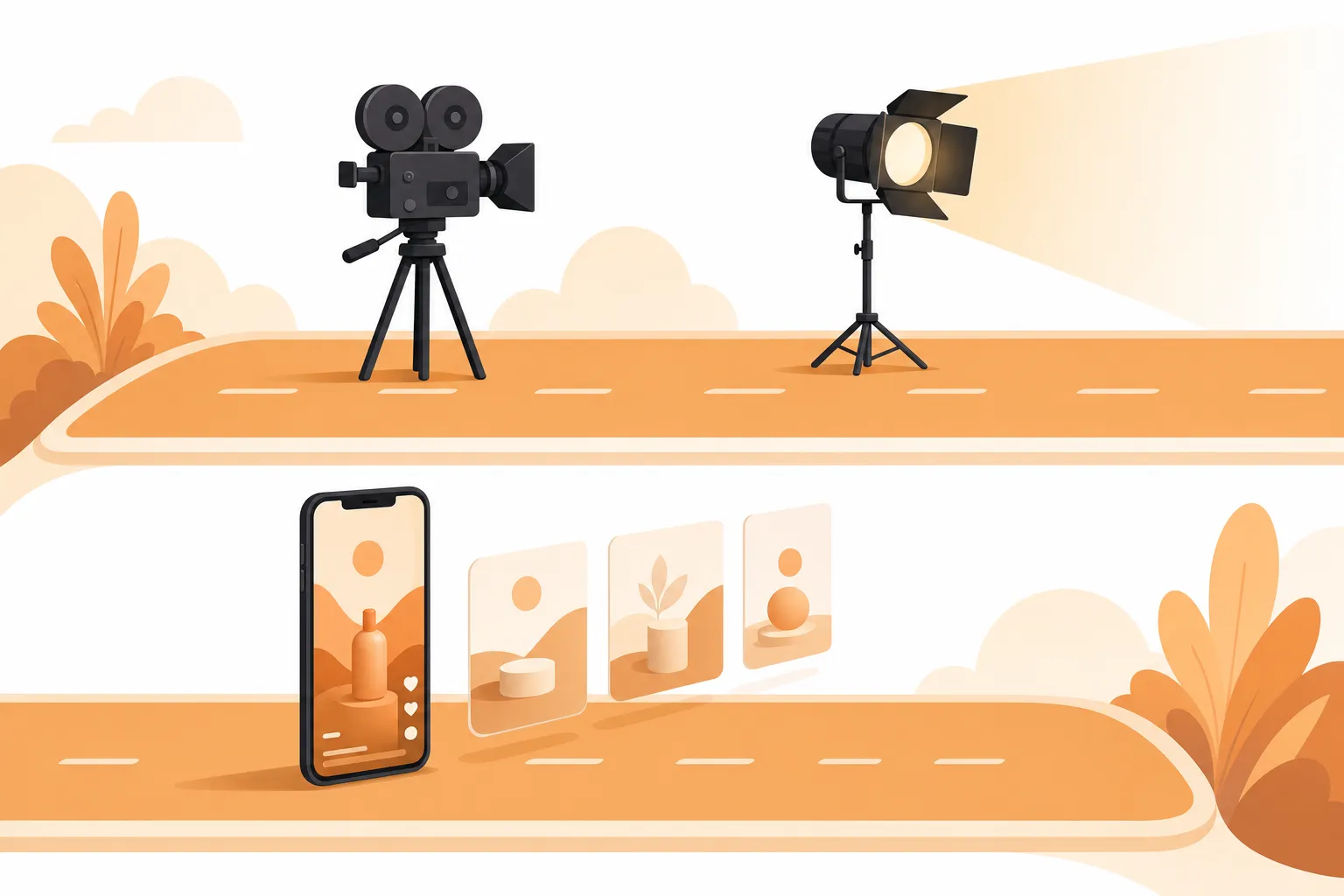
AI video just split into two lanes
The market that looked like one race in 2025 is now visibly two.
Lane one is film-grade. Frontier model training, Hollywood workflow integration, capital-intensive, measured in quarters and millions. Its buyer is a studio, an agency, or a filmmaker whose constraint is fidelity — the difference between "generated" and "shot". That is the lane Katzenberg and Peebles are reportedly entering.
Lane two is ad-grade. Its constraint is not fidelity at all, it is throughput: how many credible, product-accurate variants can you put in front of a feed this week, and can you afford to lose most of them. This lane is already commoditized — platform-native tools inside Google Ads and Meta, model APIs you can rent by the second, and pipelines that turn a product page into a finished ad.
Both lanes are growing. They are not substitutes, and buying into one does not solve the other's problem.
Why the film-grade lane barely moves your numbers
The honest reason to be unmoved by a Hollywood-grade model is that fidelity was never your bottleneck. Look at what actually decides a paid-social creative:
- The hook. Eight to twelve words in the first 1.5 seconds. No model, at any budget, writes those for you — it renders what you wrote.
- The offer. Price, shipping, guarantee, the reason to buy now. Pure commercial input, zero pixels.
- Product truth. Whether what is on screen matches what ships. This is the axis where AI creative actually loses money, and a better renderer does not fix it.
A model trained to satisfy a director improves the ceiling on all three of nothing. It will, over time, raise the realism floor for avatar presenters and b-roll — that is real and welcome — but realism has not been the deciding variable since the first generation of these tools shipped. The variant that wins is almost always the one with the clearer claim, not the smoother motion.
There is also a structural argument. Filmmaker-grade models are built for long, expensive, high-touch renders — the opposite of what a creative-testing cadence needs. Twenty variants a month is a throughput problem, and throughput is exactly what lane two already solved.
The math that matters more than the demo
Here is the comparison an ecommerce team should actually run. Twelve finished variants in a month, each a vertical ad with a script, a presenter, a voiceover, captions, and music:
- On Prizmad, a finished avatar ad draws roughly 1,000 tokens, so twelve variants is about one month of Starter at $99 — roughly $12 per finished ad, copy included, in about five minutes each. Launch at $39 covers three; Pro at $249 covers about thirty-five.
- On a production route — human creators, or a studio brief — the same twelve testable variants are a five-figure line item and a six-week conversation.
That gap, not the fidelity gap, is why creative testing works at all now. It is also why the disclosure and claim discipline we keep writing about matters more than model news: cheap variants make it easy to ship volume that was never verified. Our talking AI avatars playbook covers that craft layer in detail, and the cost breakdown covers the full studio-to-pipeline comparison.
What to do with this news
Nothing urgent — and that is the actionable answer.
- Don't wait for the Hollywood model. The lane that serves your ads already exists and costs less than a lunch per variant. Waiting for a filmmaker-grade renderer to fix your creative is waiting for the wrong thing to get better.
- Keep the loop short. Paste a product URL, get a finished ad, spend your time on the second hook. Prizmad's pipeline returns one in about five minutes, which is the point.
- Decide the claim before you generate. Cheapest possible place to catch a compliance problem is the script, not the ad account.
- Test in pairs, not in bulk. Same body, two hooks. Otherwise a batch of twenty variants teaches you nothing about which variable moved.
- Watch the frontier lane's cost curve, not its demos. When film-grade generation gets cheap enough to run at variant volume, it becomes relevant to performance marketers. Until then it is a signal about where the industry's compute is going — which is exactly what it is this week.
We have written this story before in a different shape: when Runway's world models made the creative unit wider than the video file, and when the IAB raised its 2026 ad spend forecast, the same conclusion surfaced from the other direction — budgets are moving faster than creative supply, and the constraint sits on the creative side. Hollywood training its own video models does not change that. It just confirms where the money thinks the future is.
If you want to see the lane you can use today, start from a product URL — no card, and a finished variant in about five minutes.