
GPT Image 2.5 Is Now in Prizmad's AI Studio
GPT Image 2.5 is live in Prizmad's AI Studio: 4K stills and product-photo edits at 11 tokens per default image, from $39/mo — what it changes for ad teams.
On this page
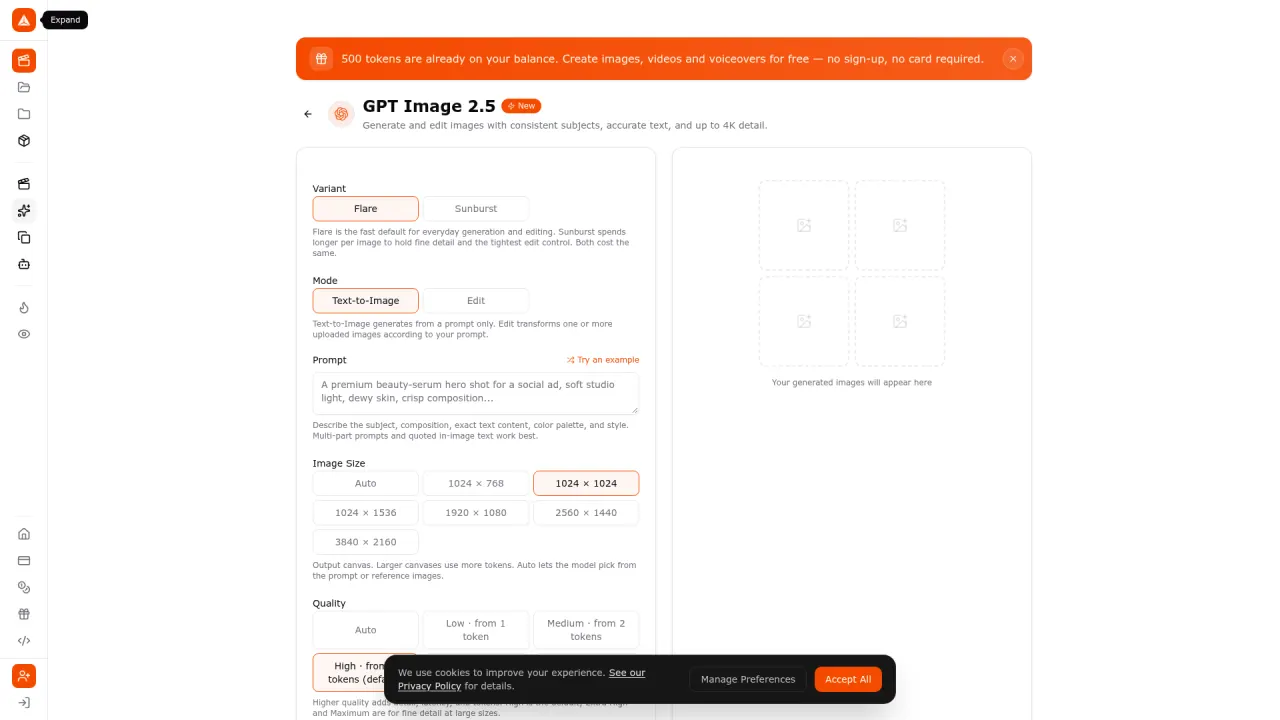
We shipped a new tool inside Prizmad's AI Studio this week: GPT Image 2.5. It generates ad-ready stills from a text prompt and edits up to sixteen product photos at once, holding subjects, packaging and typography together across styles — up to 4K output, at 11 tokens for a default 1024 × 1024 image.
It is an image model, not a video model, and that is the point. A UGC video ad is assembled from assets: the product hero frame the viewer sees first, the cover still the platform shows before playback, the packshot that has to match what lands on the doorstep, the cut-out that goes into a catalog layout. Most ad teams still buy those assets from a shoot, a stock library, or last year's photoshoot folder. This tool makes them a generation, priced per image before you press the button.
Two variants, two modes, one price
The tool exposes the model as a small, honest set of choices rather than a prompt lottery.
| Field | Options | Notes |
|---|---|---|
| Variant | Flare (fast, default) / Sunburst (slower, fine detail) | Identical pricing — the trade is time, not tokens |
| Mode | Text-to-Image / Edit | Edit takes 1–16 reference images plus an optional PNG mask |
| Image Size | Auto, 1024 × 768, 1024 × 1024, 1024 × 1536, 1920 × 1080, 2560 × 1440, 3840 × 2160 | Larger canvas, more tokens |
| Quality | Auto, Low (from 1 token), Medium (from 2), High (default, from 8), Extra High (from 13), Maximum (from 29) | The default pair is High at 1024 × 1024 = 11 tokens |
| Background | Auto / Transparent / Opaque | Transparent returns a real alpha channel — pair it with PNG or WebP |
| Output | PNG, JPEG, WebP · 1–4 images per run | Each image is billed on its own |
| Prompt | Up to 8,000 characters | Multi-part prompts and quoted in-image text work best |
Turnaround is roughly 20–60 seconds. Larger canvases and higher quality levels add both detail and latency, which is why the quality ladder is priced rather than hidden.
What it costs, in the tokens you already buy
Prizmad prices every image tool the same way: 2× the provider's published per-image cost at a 50% margin, and 1 token = $0.01. GPT Image 2.5 publishes a per-image price for each canonical size at every fixed quality level, so nothing here is estimated.
At the default settings — High quality, 1024 × 1024 — an image costs 11 tokens: about $0.14 at the Launch plan's effective rate ($39 for 3,000 tokens) and about $0.08 on Pro ($249 for 35,000 tokens). The floor is a Low-quality small still at 1 token; the ceiling is a Maximum-quality 3840 × 2160 render at 81 tokens. Editing adds the reference images as billed image input, at a conservative per-image basis of $0.012, so a four-reference edit on the default canvas lands at 21 tokens.
That is a very different cost shape from a photoshoot, and it is worth doing the division out loud:
| Plan | Price | Tokens | Default images (11 tokens) |
|---|---|---|---|
| Launch | $39/mo | 3,000 | ≈270 images |
| Starter | $99/mo | 8,000 | ≈720 images |
| Pro | $249/mo | 35,000 | ≈3,180 images |
For scale: a finished AI UGC video ad runs about 1,000 tokens in our pipeline. So the $39 entry plan is either three finished ads or roughly 270 stills — which is the real decision this tool creates. Stills are cheap enough to be disposable; video ads are not.
The ecommerce workflow it actually unlocks
Four jobs, all of them things ad teams already do by hand:
Catalog product stills. Upload the real packshot, ask for a clean studio background, get the same product with the label intact. Because the edit keeps the uploaded product rather than re-drawing it from a description, the result is a usable asset — provided you check it.
Ad-native layouts. 1024 × 1536 for vertical placements, 1920 × 1080 for feed and YouTube end cards. Transparent-background PNGs drop straight into a template without a cut-out step.
Text that is actually spelled right. On-pack claims, price badges and headline text inside an image used to be the part of AI generation you had to fix in Photoshop. Prompt-level control over exact text content is the headline capability here — and still the part to verify before publishing.
Variant supply. Generate four images of the same shot from the same prompt in a single run, then pick one. The bottleneck for most ecommerce teams stopped being the render and became the number of distinct assets worth testing.
The honest limits
- No seed field. The model is not seed-reproducible, so the same prompt twice is not the same image. If a frame is approved, keep the file — you cannot regenerate it. This is a deliberate omission in our tool, not an oversight: the provider's request schema has no seed input.
- Edits move fine detail. Our own guidance in the tool says it plainly: AI edits may change fine product details, labels and typography. Review before publishing. A generated label is not a compliant label.
- A still is not a hook. Better product images do not fix a weak offer or a slow first second. Images feed the pipeline; the script and the claim still decide performance.
- Disclosure still applies. If an image in your ad is AI-generated, the platform and regulatory rules for AI-labelled creative do not disappear because the asset is cheap — our disclosure checklist covers what to state and where.
What to do this week
- Pick three to five hero SKUs — the products that carry most of your spend.
- Feed the real product photo into Edit mode, not a description. Hold the label and packaging fixed, change only the environment.
- Generate four variants, keep the two that survive a legibility check, discard the rest. At 11 tokens each the economics of looking are trivial.
- Take the winner into the URL-to-ad pipeline and put it in front of a real audience — the still is the ingredient, the video ad is the product.
- Watch your token spend on the first batch, not on a spreadsheet assumption — the cost guide breaks down what a finished creative costs on each plan.
GPT Image 2.5 is live in AI Studio now, alongside the video models we shipped earlier this month — Seedance 2.5 and MiniMax H3 — and the same token balance covers both. If you want to see the stills-in, video-out loop end to end, start with a product URL: we turned the whole pipeline into one field.