
Akool Review (2026): The Face-Swap-to-Live-Avatar Everything Platform
Akool is one of the broadest AI visual platforms of 2026 — talking avatars, video-grade face swap, talking photos, real-time streaming avatars, video translation, and image generation under one credit pool. Quality is genuinely strong (a 4.8/5 G2 rating and enterprise logos like Coca-Cola back that up), but it's a toolkit, not a workflow: for DTC ad creatives you still script, assemble, and edit everything yourself, and the credit math plus opaque public pricing take real attention. Buy it for creative range; look elsewhere if your output is finished ads on a schedule.
What is Akool?
Akool is an AI content platform built around synthetic faces and video. Its best-known feature is face swap — replacing a face in any image or video, including a live camera feed — but the suite has grown far wider: Avatar Video and Talking Avatar render a script through a lip-synced presenter, Talking Photo animates a single still image into a speaking head, Streaming Avatar puts a real-time conversational avatar on a live call or kiosk, and Video Translation re-voices existing footage with synced lips. Around the video core sit an image generator, background changer, voice cloning, text-to-speech, and a stack of swap tools (character, motion, head, even hair swap).
The company positions itself upmarket: SOC 2 compliance, a dedicated Trust & Safety team, an Inc 5000 #1 ranking, and customer logos including Canon, Google Cloud, AWS, Coca-Cola, and Qatar Airways. It claims 10M+ users, 73K+ companies, and 300M generated AI assets. Rendering claims center on 'photorealistic 4K' output with temporal consistency — keeping a swapped or generated face stable across frames — and in practice Akool's face swap is among the cleanest consumer-accessible implementations, which is why it shows up in marketing localization, entertainment, and personalization use cases rather than just novelty clips.
Everything runs on one pool of monthly credits, and each feature burns them at a different rate: third-party trackers list avatar video at roughly 5 credits per 10 seconds, video face swap at about 10 credits per 10 seconds, and image-to-video at a steep ~25 credits per 5 seconds (Akool doesn't publish a consolidated rate card, so treat these as indicative and check inside the app). Plans also gate hard limits — resolution scales from 1080p on the free tier to 4K/8K/16K up the ladder, max video length from 15 to 60 minutes, and API access starts at Pro Max.
Who is it for? Akool fits creative teams and agencies that need many kinds of synthetic visuals — a swapped face for a localized campaign here, a talking-photo greeting there, a live avatar for an event booth. For DTC advertisers, it produces excellent raw ingredients (a presenter clip, a swapped-face variant of winning footage) but no finished ad: script, product footage, captions, music, and assembly all remain your job.
Official site: akool.com
Akool up close

Akool key features
Face swap (image, video, and live)
Akool's signature feature and still its strongest. Swaps hold up in motion — identity stays stable across frames instead of flickering — and the live camera variant works in real time for streams and calls. It's genuinely useful for localizing ad creative with different presenters, though the same power is why Akool pairs it with a Trust & Safety team and acceptable-use guidelines: you're responsible for having rights to any face you upload.
Talking avatars and avatar video
Script in, lip-synced presenter out — the standard avatar workflow, with a stock library plus custom avatar options. Output quality is solid mid-pack for 2026: cleaner than budget tools, but HeyGen's flagship engine still leads on micro-expressions. At roughly 5 credits per 10 seconds (per third-party rate trackers), a minute of avatar video costs about 30 credits.
Talking Photo
Animates one still image into a speaking head with synced lips and facial motion. It's fast and surprisingly expressive for greetings, personalization, and social content, but a single source photo can only carry so much — head movement and angles are limited compared to a true avatar render, and it burns credits at about twice the avatar-video rate.
Streaming Avatar (live, real-time)
A real-time conversational avatar you can put on a website, kiosk, or live stream — one of the features that separates Akool from render-only competitors. Latency is low enough for actual conversation, and it's the basis of Akool's AI support-agent pitch. Niche for advertisers, but a legitimate differentiator for events, retail, and customer-facing deployments.
Video translation with lip sync
Re-voices existing footage into other languages with re-synced lips and preserved facial expressions. Among the cheapest features on the credit menu (~1 credit per 5 seconds per third-party trackers), which makes it a practical path for localizing winning creatives — the usual caveat applies: have a native speaker check scripts in markets that matter.
Image tools and the wider swap stack
Image generation, background change, and the character/motion/head/hair swap tools round out the suite. Individually none is best-in-class versus dedicated image tools, but having them under the same credit pool means one subscription covers a lot of ground — the classic everything-platform trade of breadth over per-tool depth.
Akool pricing
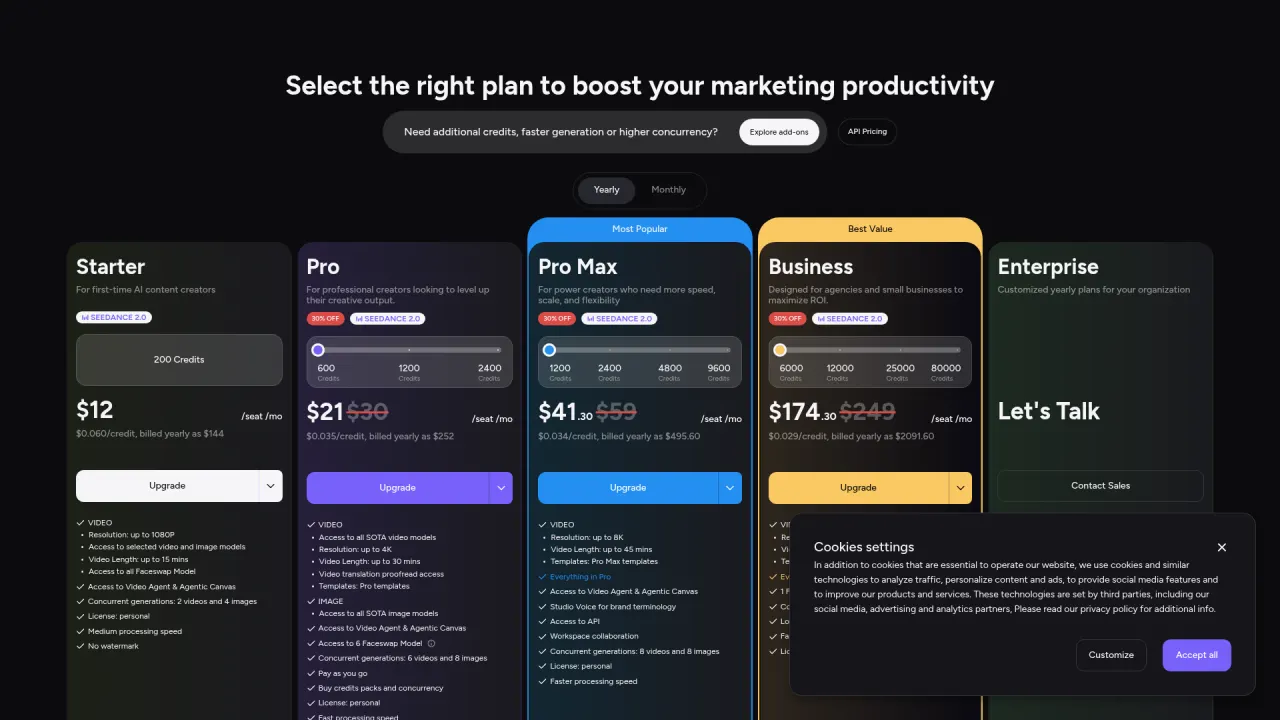
| Plan | Price | What you get |
|---|---|---|
| Free (Starter) | $0 | Limited monthly credits, 1080p, 15-min max video, 5GB storage, full-screen watermark |
| Pro | ~$30/seat/mo (~$21/mo billed annually) — see vendor site | 600 credits/mo (~20 min of 1080p avatar video), 4K export, 30-min max video, watermark removed, pay-as-you-go credit top-ups |
| Pro Max | ~$59/seat/mo (~$41/mo billed annually) — see vendor site | 1,200 credits/mo (~40 min avatar video), 8K export, 45-min max video, faster processing, API access starts here |
| Business | ~$249/seat/mo (~$174/mo billed annually) — see vendor site | 6,000 credits/mo (~200 min avatar video), 16K export, 60-min max video, up to 1TB storage, lowest cost per credit, overage billing |
| Enterprise | Custom | Custom credits and storage, credit-expiry exemptions, dedicated support — contact sales |
Plan structure and limits verified July 2026 on akool.com/pricing — but the vendor page doesn't expose dollar figures to fresh page loads, so the prices above are as reported by third-party pricing trackers (June 2026): roughly Pro $30/mo, Pro Max $59/mo, Business $249/mo, ~30% off annual. Confirm current prices on akool.com/pricing before buying. Two caveats reported consistently: unused credits expire each billing cycle on standard paid plans, and every added workspace member costs a full extra seat.
Pros and cons
What Akool does well
- Exceptional breadth: face swap, avatars, talking photos, live streaming avatars, video translation, and image tools under one subscription
- Face swap quality — including video and real-time live swap — is among the best available to non-enterprise buyers
- Streaming Avatar enables real-time conversational use cases most render-only rivals can't touch
- Enterprise-grade trust signals: SOC 2 compliance, dedicated Trust & Safety team, and customers like Coca-Cola, Canon, and Qatar Airways
- Video translation is cheap on the credit menu, making creative localization economical
- High resolution ceilings (4K on Pro up to 16K on Business) and pay-as-you-go credit top-ups for burst workloads
Where it falls short
- Opaque public pricing: the official pricing page doesn't show dollar amounts to fresh visitors, and third-party sources disagree — you effectively learn the real price at checkout
- Unused credits expire at the end of each billing cycle on standard paid plans, so uneven months waste money
- Per-feature credit burn varies widely (image-to-video reportedly costs ~15x video translation per second of output), making budgets hard to predict
- It's a toolkit, not an ad pipeline: no product-URL ingestion, no performance-copy generation, and final ad assembly is entirely manual
- Face swap's power cuts both ways — you carry the compliance burden of consent and rights for any real face you upload, and platform acceptable-use review can affect edge-case content
Akool vs Prizmad
Akool and Prizmad solve different problems. Akool is a horizontal synthetic-media toolkit — the widest one in this review series — where each tool outputs an ingredient: a swapped face, an avatar clip, a translated video. Prizmad is a vertical ad pipeline: paste a product URL and about 5 minutes later you have a finished UGC-style video ad with the script written, a lip-synced avatar (50+ to choose from), voiceover, captions, and music already composited, plus an AI Studio with 30+ tools around it. With Akool you leave with footage and open your editor; with Prizmad you leave with the ad.
The honest split: if your work needs face swap, live avatars, or many kinds of synthetic visuals — agency work, localization, events, personalization — Akool's range is the draw and Prizmad doesn't attempt most of it. If your output is DTC ad creatives measured in tests shipped per week, Prizmad's pricing maps directly to finished ads (Launch $39/mo with 3,000 tokens, Starter $99/mo with 8,000 tokens for roughly 8 avatar videos, Pro $249/mo with 35,000 tokens, full commercial rights on every plan) while Akool's credits map to raw minutes you still have to script and cut into ads yourself.
| Akool | Prizmad | |
|---|---|---|
| Entry paid price | ~$30/mo Pro, 600 credits (per third-party trackers; vendor page hides prices) | $39/mo Launch (3,000 tokens), published openly |
| What the entry plan buys | ~20 min of raw 1080p avatar video — you script and edit around it | Finished UGC-style ads: script + avatar + voiceover + captions + music |
| Time to first finished ad | Hours: script, render clips, then assemble product shots, captions, music | ~5 minutes from pasting a product URL |
| Creative range beyond ads | Face swap (incl. live), streaming avatars, talking photos, translation, image tools | Focused ad-creative pipeline + AI Studio (30+ tools) |
| Real-time / live avatar use | Yes — Streaming Avatar and live face swap | No — rendered ad videos only |
| Credit predictability | Per-feature burn rates vary widely; unused credits expire monthly | Tokens map directly to finished videos (~8 on Starter) |
| Commercial rights | Yes — no restrictions on distribution of created videos per Akool, within acceptable-use guidelines | Full commercial rights on all plans |
| Best-fit user | Agencies and creative teams needing many kinds of synthetic visuals | DTC founders and media buyers shipping ad-creative volume |
Who should use Akool?
Choose Akool if
- Agencies and creative teams that need face swap, avatars, translation, and image tools under one roof
- Brands localizing campaigns — swap presenters and re-voice footage without reshooting
- Anyone deploying real-time avatars: live streams, kiosks, events, or conversational support agents
- Enterprises that need SOC 2 compliance and a vendor with a formal Trust & Safety function behind sensitive face tech
- Developers on Pro Max or above who want face-swap and avatar capabilities via API
Look elsewhere if
- DTC marketers who want a finished, ready-to-launch ad from a product link — Akool outputs ingredients, not ads
- Buyers who want transparent pricing before signing up: the public pricing page doesn't show real numbers
- Teams with uneven monthly workloads — credits expiring every billing cycle punishes bursty usage
- Solo operators without editing time or an editor on call
- Anyone whose only need is a standard talking-head avatar video — simpler, cheaper single-purpose tools cover that
Top Akool alternatives
Want the full ranked list with pricing? Akool alternatives — 5 tools compared.
HeyGen
The avatar-quality leader — best-in-class realism and 175+ language translation, minus Akool's face-swap and live-swap stack.
Prizmad
URL-to-ad pipeline: paste a product link, get a finished UGC-style ad with avatar, voiceover, captions, and music in ~5 minutes.
Synthesia
The corporate avatar platform — stronger governance and L&D workflows, no face-swap ambitions.
Vidnoz
Budget avatar and face-swap generator with a generous free tier — less polish, much lower cost.
DeepBrain AI
Realistic avatars with a kiosk/broadcast heritage — overlaps with Akool's live-avatar use cases at the enterprise end.
Akool review verdict
Akool earns a 4.1: the face-swap engine is legitimately best-in-class for accessible tools, the breadth (live avatars, talking photos, translation, image tools) is unmatched among the platforms we've reviewed, and the enterprise trust posture — SOC 2, a real Trust & Safety team, blue-chip customers — matters for a technology this sensitive. The deductions are for the buying experience and the accounting: a pricing page that won't show you prices, credits that expire monthly, and burn rates that vary by an order of magnitude across features.
The decision is about output. If your work is synthetic visuals in the plural — swapped faces for localized campaigns, a live avatar for a booth, a talking photo for personalization — Akool consolidates tools you'd otherwise buy separately, and it's a strong pick. If your output is DTC ad creatives, Akool hands you excellent raw material and none of the assembly: scripting, product footage, captions, music, and editing all live outside the platform.
For that job, a purpose-built pipeline like Prizmad ($39/mo entry, ~5 minutes from product URL to finished ad, full commercial rights) ships more tests per week for less effort — and the two aren't mutually exclusive: some teams use Akool's face swap and translation to multiply a winning creative across markets while Prizmad produces the base ads.
Rating: 4.1/5 · Last reviewed 2026-07-26 · Prices and limits change often in this space — if you spot something outdated, tell us.
Akool — frequently asked questions
What is Akool?
Akool is an AI content platform centered on synthetic faces and video: face swap for images, video, and live camera feeds, talking avatars, talking photos, real-time streaming avatars, video translation with lip sync, and image generation, all billed from one monthly credit pool. It's used by creative teams and enterprises — Akool lists Canon, Coca-Cola, and Qatar Airways among its customers.
Is Akool safe and legit?
Akool is a legitimate company — it reports 10M+ users and 73K+ companies, holds a 4.8/5 G2 rating, states SOC 2 compliance, and operates a dedicated Trust & Safety team, per its own site. As with any face-swap technology, safety in practice depends on use: Akool requires uploads to follow its acceptable-use guidelines, and you are responsible for having rights and consent for any real person's face you use.
How much does Akool cost?
Akool's official pricing page doesn't display dollar amounts to fresh visitors, so exact prices are only confirmed at checkout; third-party pricing trackers (June 2026) report roughly $30/mo for Pro (600 credits), $59/mo for Pro Max (1,200 credits), and $249/mo for Business (6,000 credits), with about 30% off on annual billing. There's also a free tier with a watermark — verify current numbers on akool.com/pricing.
How do Akool credits work?
Every feature draws from one monthly credit pool at its own rate — per third-party rate trackers, avatar video runs about 5 credits per 10 seconds, video face swap about 10 per 10 seconds, and video translation about 1 credit per 5 seconds. Two things to watch: unused credits expire at the end of each billing cycle on standard paid plans, and Akool doesn't publish a consolidated public rate card, so check burn rates inside the app.
Does Akool have a free plan?
Yes. The free Starter tier includes a limited credit allocation, 1080p output, up to 15-minute videos, and 5GB of storage, with a full-screen watermark on exports. It's enough to judge face-swap and avatar quality, but the watermark rules out any production or commercial use.
Can I use Akool videos commercially and in ads?
Yes — Akool states there are no restrictions on usage or distribution of created videos, provided your inputs follow its acceptable-use guidelines. The practical burden sits with you: for face swap especially, you need rights or consent for any real person's likeness, and ad platforms apply their own synthetic-media disclosure rules on top.
Akool vs HeyGen — which is better?
HeyGen for pure avatar realism and translation depth; Akool for range — face swap (including live), streaming avatars, and talking photos that HeyGen doesn't offer. If you only need script-to-presenter videos, HeyGen's flagship engine still produces the most convincing output; if swapping and real-time use cases are on your list, Akool is the broader buy. Neither produces a finished DTC ad from a product link — that's a different category of tool, like Prizmad.
Does Akool create complete ads from a product link?
No. Akool renders avatar clips, face swaps, and translated footage from inputs you supply; it doesn't ingest a product URL, write ad copy, or composite product shots, captions, and music into a finished creative. Tools like Prizmad are built for that pipeline, turning a product URL into a finished UGC-style ad in about 5 minutes.