
Localizing AI UGC Ads: The 2026 Global Ads Playbook
Localize AI UGC ads in 2026: verified Meta, TikTok, YouTube and Google Ads dubbing tools, EU AI Act and disclosure rules, per-market playbooks, and the cost math.
On this page
The cheapest CPM improvement you will make this year is probably not a new hook, a new offer, or a new creative angle — it's running the creative you already validated in a second, third, or tenth language. CSA Research's "Can't Read, Won't Buy" survey (8,709 consumers in 29 countries, 2020) found that 76% of online shoppers prefer products with information in their own language, and 40% say they will never buy from a site in another language. For paid social, the implication is direct: a proven English hook shipped to a German, Brazilian, or Thai feed in English is leaving most of the addressable audience on the table — and the 2026 platform stack now has specific, verifiable tools for closing that gap.
AI UGC is uniquely positioned for localization because the marginal cost of a variant is near zero. A human UGC shoot has to be re-shot, re-licensed, and re-edited per market. An AI UGC pipeline re-renders the same validated structure with a different script, voice, avatar, and caption track for the price of a few tokens. This playbook covers the verified 2026 platform dubbing tools (Meta, TikTok, YouTube, Google Ads), the transcreation rules that separate ads that convert from ads that just translate, the per-market compliance layer (EU AI Act Article 50, state laws, platform labels), and the cost math that makes localization a media-buy decision rather than a production one.
Why localization is the highest-leverage move in AI UGC
Four mechanics make localized creative disproportionately valuable in 2026:
- Language is a hard filter on conversion, not a soft preference. The CSA Research numbers are the cleanest summary: 76% prefer to buy in their own language, 40% will not buy at all without it, 75% are more likely to repurchase when support is in their language, and 65% prefer their own language even when the translation quality is poor. For a DTC store selling internationally, an English-only ad is filtering out up to 40% of the potential audience before the auction even finishes.
- Creative fatigue is a frequency problem, and localization resets it. The same video rotated past 8+ frequency dies. A localized variant — same structure, native language, native presenter energy — reads as fresh creative to both the viewer and the delivery algorithm, because the platform measures engagement on the localized asset, not on your original.
- AI UGC makes per-market variants cheap enough to test. The entire economics argument collapses if localization costs studio rates. With an AI pipeline, the marginal localized render costs roughly the same as the original render — see the cost math section for the exact numbers — which means you can localize hooks that are winning, not just localize everything on spec.
- The platforms are building dubbing into their own stacks. Meta, TikTok, YouTube, and now Google Ads all ship AI dubbing/translation features in 2026. They are not all usable for paid ads yet, and none of them removes the need for a localized landing page — but they change what "localized" means operationally, which is why the next section goes through each one with verified specifics.
The anatomy of a localized AI UGC ad
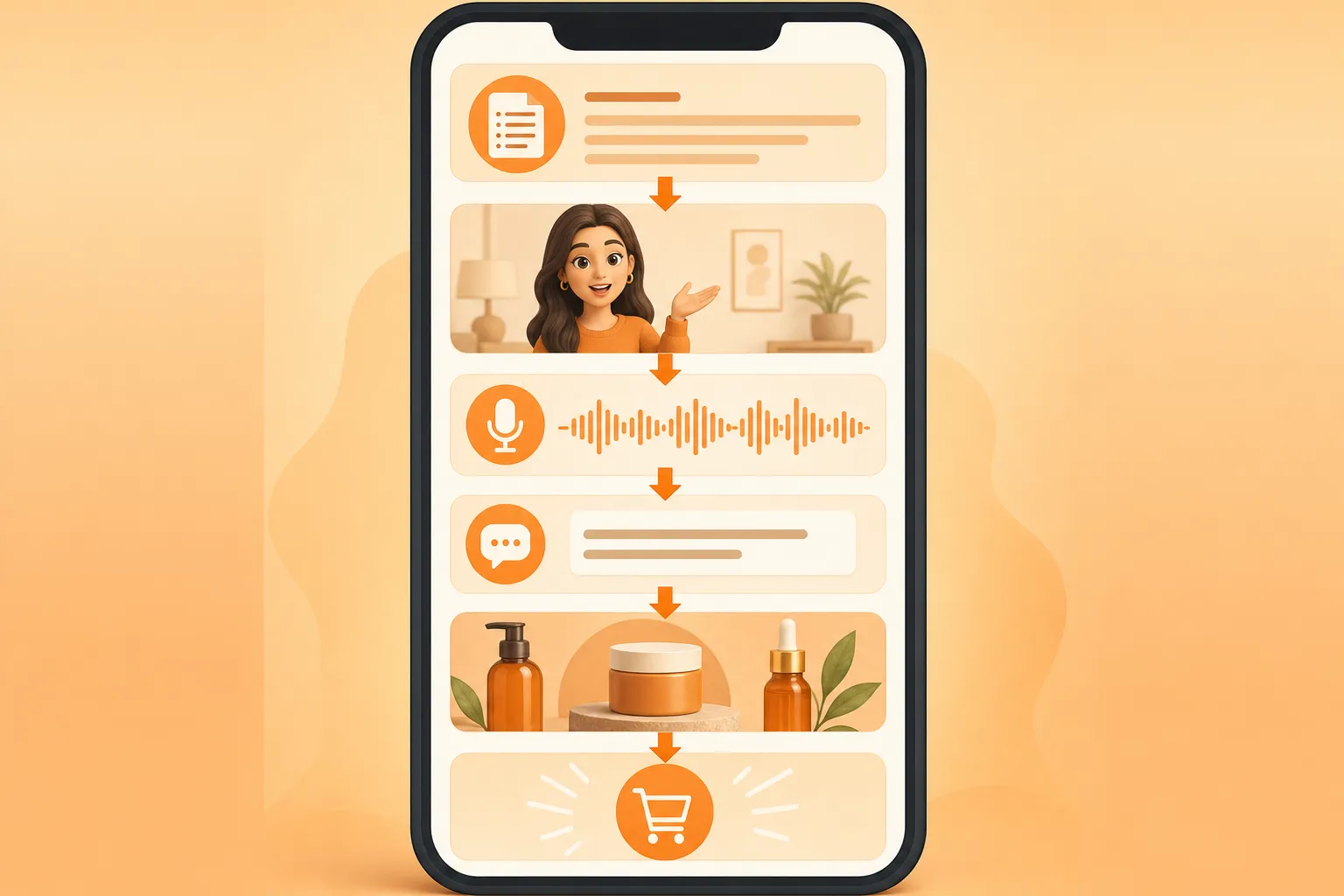
A localized AI UGC ad is not "the same ad with subtitles." It is six layers, and each one either helps or hurts conversion in the target market:
- Script transcreation (not translation). The hook, the objection handling, and the CTA have to be re-authored for how the target market buys, not word-for-word converted. A direct translation of an English urgency hook ("last chance!") lands differently in Germany, where direct pressure reads as pushy, or in Japan, where scarcity framing works but loudness doesn't.
- Avatar selection. Face perception is cultural. A presenter that reads as trustworthy in California can read as salesy in Seoul or out of place in Riyadh. The avatar should match the market's presentation norms — dress, setting, energy, age — not just the language.
- Voiceover. This is where dubbing tools and AI voice pipelines earn their keep: same script, native speaker accent, correct rhythm for the language. Voice quality is the fastest way to kill a localized ad — a synthetic voice with English prosody speaking Spanish is instantly clocked as fake.
- Captions and on-screen text. Most feed views are muted, so the localized caption track is the primary message carrier in many markets. On-screen text must be re-set for language length (German runs long, Japanese compresses), and the platform safe zones still apply in every language.
- Visual culture. Currency symbols, date formats, unit measurements, packaging differences, color and gesture associations, local payment and delivery trust signals — the visual layer of the ad has to match the market's expectations, not just the audio layer.
- The offer and landing page. The ad can be perfectly localized and still fail if the landing page, prices, payment methods, and shipping promises are not localized too. Platform policy in several places (notably TikTok Shop) explicitly checks that the landing experience matches the ad — see the compliance section.
What the platforms can auto-dub in 2026 (verified)
The 2026 dubbing landscape splits into creator/organic tools and advertiser tools. All four majors ship something; the differences matter for paid media.
| Platform | Tool | What it does (verified) | Advertiser usable? |
|---|---|---|---|
| Meta (Instagram/Facebook) | Meta AI Translations for Reels | Auto-dubs and lip-syncs Reels using the creator's own voice and tone; languages as of the latest update: English, Spanish, Hindi, Portuguese, with Bengali, Tamil, Telugu, Marathi, and Kannada rolling out; single-speaker videos work best; free | Not directly — applies to organic Reels, not paid creative |
| TikTok | Symphony Creative Studio — Translate & dub | Upload a video, pick target language(s), clone the original voice or use a stock voice, toggle lip-sync and subtitle replacement; works best with one speaker and clean lighting; an AI-generated label is added to all exported videos; export straight to Ads Manager | Yes — built for ad creative |
| YouTube | Automatic dubbing | Generates translated audio tracks for videos; expanded to 27 languages; "Expressive Speech" mode mirrors pitch, intonation, and energy in eight key languages (English, French, German, Hindi, Indonesian, Italian, Portuguese, Spanish — per third-party Metricool coverage) | Indirectly — creator-side; applies to organic videos and can carry into TrueView/Shorts organic reach |
| Google Ads | Video Ads Dubbing in Asset Studio | Translates and dubs the voice track of an existing video ad into 33 languages and locales; free for the advertisers who have access, availability limited; Google has published no announcement and no help page, so voice type, lip-sync and translation control are unspecified; first seen as an internal, access-denied tool in October 2025 | Yes — lives inside the ad account, rolling out to select advertisers |
Two nuances are easy to miss:
- Meta's Reels dubbing is a creator feature, not an ad feature. You cannot upload an ad creative into Ads Manager and have Meta dub it for you. But the feature changes the competitive bar: organic Reels content in your category is now being served in multiple languages, so an English-only paid creative next to a dubbed organic feed looks under-produced.
- Google's entry is the newest and the least documented of the four. It dubs the audio track of an existing video ad and leaves everything burned into the picture — on-screen text, packshots, subtitles, legal lines — in the language of the original shoot. Reported by Search Engine Land on September 18, 2026 and covered in more detail in our blog post on the rollout.
- TikTok's Symphony pipeline is the most complete for advertisers because it was built for creative production: language selection, voice cloning, lip-sync, subtitle replacement, and the mandatory AI label are all part of one export flow. The label point is worth repeating — every video exported from Symphony gets an AI-generated label, so "undisclosed AI" is not an option on that path.
The honest 2026 reality for paid media: production-time localization is still the advertiser's job. Platform auto-dubbing helps organic reach, and on TikTok and Google Ads it reaches into the ad workflow — but neither touches the script, the on-screen text, the claims or the landing page. A serious multi-market ad program localizes at generation time, where script, voice, captions, and visuals are all controlled.
Dub, re-avatar, or reshoot: the decision framework
| Situation | Recommended move | Why |
|---|---|---|
| Single speaker, simple demo, low cultural friction (unboxing, feature demo, routine) | Dub/relocalize voiceover + captions | Fastest, cheapest; keep the same avatar and structure |
| Presenter credibility is market-specific (beauty in Korea, finance in Germany, fashion in France) | Re-avatar | The face is part of the message; swap to a market-appropriate presenter |
| Claims, packaging, or offer differ by market (supplements, health, finance, regulated categories) | Reshoot/rebuild the affected beats | Compliance and claim differences can't be fixed with a dub; the same claim may be illegal in one market and fine in another |
| Organic content program, not paid | Platform auto-dub (Meta/YouTube) | Free, scales, but you don't control quality or claims — review what ships |
The framework exists because the cheap option (dub everything) is not always the right option. Dubbing preserves the original's energy but inherits its cultural framing. Re-avataring fixes the face but costs an extra render. Reshooting is for when the message itself has to change, not just its packaging.
Localization is not translation: transcreation rules for UGC
These are the rules that separate an ad that converts in the target market from an ad that merely exists in it. They apply whether you use an AI pipeline, a human translator, or a hybrid.
- Hooks don't translate — they transcreate. "POV: you finally found a serum that works" works because of cultural context around POV-format and skincare skepticism. The German equivalent is not a literal translation; it's a hook that triggers the same emotional reflex in German: "Ich habe 30 Cremes getestet, damit du es nicht musst" ("I tested 30 creams so you don't have to"). If the target-language hook doesn't sound like something a native creator would say, rewrite it.
- CTA verbs differ by market and platform. English CTAs (Shop now, Learn more, Try it free) map to platform button text, but the spoken CTA in the script needs a native urgency pattern. German ecommerce responds to concrete, benefit-led CTAs; Brazilian Portuguese responds to warmer, more personal ones; Japanese CTAs favor politeness and clarity over pressure.
- Numbers are cultural, not just linguistic. Currency, prices, dates, sizes, and measurement systems all need market-correct formatting. A "$39" price tag shown as-is in a German or Japanese ad signals "this ad was not made for me" instantly — localize the offer display, not just the words.
- Payments and trust signals are part of the creative. Klarna in the Nordics and Germany, Pix in Brazil, local wallets in SEA, deferred payment in Japan — showing the payment method the market actually uses is a conversion signal that subtitles can't carry.
- Humor, slang, and idioms are landmines. Wordplay and cultural references rarely survive translation. When in doubt, cut the joke and keep the product proof — the downside of a joke that flops is worse than no joke at all.
- Visual taboos are regional. Hand gestures, colors, and imagery carry different meanings (green in Indonesia, certain hand signs in MENA, showing soles of feet in parts of Southeast Asia). The AI UGC pipeline makes it cheap to generate region-appropriate visuals — use that freedom instead of shipping one global visual.
Per-market playbook (2026)
Directional guidance, not legal advice — ad law varies and changes; verify against local counsel before scaling a market. Prices and compliance references below are general market notes, not claims about any specific product's status.
| Market cluster | Language/creative notes | Compliance notes |
|---|---|---|
| US & Canada | English; split US vs CA English (spelling, offers); French for Quebec | Platform AI labels; NY synthetic-performer disclosure for AI avatars reaching NY audiences; FTC substantiation for claims |
| UK | British English, UK pricing conventions, GBP | ASA/CAP Code: AI-generated ads still bound by misleading-ad rules; virtual influencers treated as endorsements |
| Germany, Austria, Switzerland (DACH) | German; formal "Sie" vs informal "du" by category and audience; long-form product detail | UWG unfair-competition law: strict on misleading claims and undisclosed advertising; EU AI Act applies |
| France, Spain, Italy, Netherlands | French/Spanish/Italian/Dutch; local payment preferences; strong local retail trust signals | EU AI Act Article 50 applies to ads reaching EU consumers in deepfake-style scenarios; platform AI labels |
| Brazil | Brazilian Portuguese (pt-BR), not European PT; Pix prominently; warm, personal tone | CONAR self-regulation expects AI-content transparency; claim substantiation enforced |
| Japan | Japanese; polite, concrete, trust-first tone; deferred-payment options; app-store cultural conventions | Strict advertising law (the Premiums and Representations Act) on exaggerated claims; AI-avatar ads should be clearly labeled per platform rules |
| South Korea | Korean; fast trend cycles; strong creator-culture expectations | Platform AI labels; strict comparative-advertising rules |
| Southeast Asia (TH, ID, VN, PH) | Local languages; mobile-first, short hooks; TikTok Shop is a major conversion surface | TikTok Shop AI-product-image labeling consistency; local consumer-protection rules |
| MENA (SA, AE) | Arabic (MSA vs dialect choice), RTL layout; conservative visual norms | Local advertising codes; platform labels; cultural sensitivity in visuals |
| India | Hindi + regional languages (Tamil, Telugu, Bengali, Marathi, Kannada); value-led offers | ASCI code on advertising; AI disclosure per platform policy; claim substantiation |
Two structural notes: (1) the biggest localization wins are usually Brazil, Germany, and Japan — large ecommerce markets with strong native-language preference and high ad prices; (2) any market with TikTok Shop (SEA, Brazil, UK, US) inherits the Shop-specific AI labeling requirements on top of ad policy — see below.
Compliance for localized AI UGC

Localization multiplies your creative — and your compliance surface. The rules that apply to an English ad apply in every language, plus a few localization-specific ones.
- EU AI Act Article 50 (in force since August 2, 2026). Requires that AI-generated or AI-manipulated content be made clear when it depicts a real or plausibly-real person, object, place, entity, or event in a way that could pass as authentic — the deepfake scenario. It applies to any advertiser whose ads reach EU consumers regardless of where the company is headquartered; penalties reach €15 million or 3% of global annual turnover (Article 99). A stylized, clearly-synthetic AI avatar testimonial does not obviously trigger this; content designed to be mistaken for real footage does. The EU is still standardizing the consumer-facing label.
- California AI Transparency Act (SB 942, in force August 2, 2026). Binds providers of large generative AI systems (1M+ monthly users) — watermarking and detection obligations sit with your tool vendor, not with you as the advertiser.
- New York Synthetic Performer Law (in force June 9, 2026). Any ad reaching New York audiences with a "synthetic performer" (an AI-generated digital asset intended to look like a human performance) needs conspicuous disclosure: $1,000 first violation, $5,000 subsequent. Notably for this guide, the law carves out AI used solely to translate a human performer's own speech — a genuinely localized human-voice dub can fall outside it, while a fully AI voice reading a translated script still counts as a synthetic performance.
- Platform labels still apply in every language. TikTok requires the manual AI Disclosure tag for AI-generated elements (and Symphony adds an AI label to every export); Meta auto-labels via "AI Info" and reads C2PA provenance; Google's "How this ad was made" panel relies on advertiser self-declaration for third-party AI tools. Our AI ad disclosure labels guide has the full platform-by-platform mechanics.
- TikTok Shop consistency rule. AI-rendered product images must be labeled identically in ad creative and product listing; a mismatch triggers listing removal, which cascades into every campaign tied to that listing. When you localize a TikTok Shop ad, localize the listing's AI labeling with it.
- Local ad law is the floor. The markets in the playbook above each have their own misleading-advertising regimes (UWG in Germany, ASA/CAP in the UK, CONAR in Brazil, Japan's Premiums and Representations Act, ASCI in India). Localization does not reset claim requirements — a claim that needed substantiation in English still needs it in German.
The pattern to internalize: platform labels and AI laws are transparency rules, not creative restrictions — disclosure obligations govern whether the ad has to say it's AI, not whether it can run. The expensive mistakes in localization are claim violations and landing-page mismatches, not the label itself.
Cost math: localized AI UGC vs the alternatives
The budget question for a brand localizing, say, one winning hook into 5 languages (5 variants monthly):
| Channel | Cost per localized video | Turnaround | Notes |
|---|---|---|---|
| Studio reshoot per market | $500–$3,000+ | 2–4 weeks | Casting, set, licensing per market — the historical norm |
| Human translation + studio VO | $150–$600 | 1–2 weeks | Translation plus native voice talent per language |
| Professional dubbing house | $100–$400 per language | 3–10 days | Quality varies; lip-sync adds cost |
| AI UGC localization (Prizmad) | ≈$1.3–$8 per render | under 10 minutes per variant | Same pipeline, localized script + voice + captions |
| Platform auto-dub (Meta/YouTube) | $0 | minutes | Organic only; no control over claims/quality |
| Google Ads Asset Studio dubbing | $0 (free for accounts with access) | minutes | Select advertisers; audio track only, on-screen text stays in the shoot language |
The AI line uses current plan pricing: Launch $39/mo for 3,000 tokens (≈3 finished avatar ads), Starter $99/mo for 8,000 tokens, Pro $249/mo for 35,000 tokens (per Prizmad pricing). A Pro plan covers a full 5-language × weekly creative rotation without rethinking the budget — and because the script, voiceover, captions, and avatar are all generated in one pipeline, the localized variant is a first-class output, not a post-production add-on.
For context on the production side: Prizmad's voiceover pipeline ships 13 text-to-speech languages out of the box (English, Spanish, French, German, Portuguese, Italian, Russian, Japanese, Korean, Chinese, Arabic, Hindi, Turkish) with in-pipeline script translation for voiceover, plus 50+ avatar presets and 30+ AI Studio models — the same pipeline that produces the original ad produces the localized one. We dogfood this ourselves: prizmad.com ships in English, Spanish, Portuguese, German, and Thai.
The 2026 localization checklist
- Validate the hook in the source market first — never localize an unproven creative.
- Pick the 2–3 markets with the best product-market fit (see the per-market table), not the cheapest translation.
- Transcreate, don't translate: hook, CTA, offer, trust signals all re-authored for the market.
- Generate localized variants in one pipeline: script, avatar, voiceover, captions, visuals.
- Localize the landing page, prices, currency, and payments — the ad is a promise, the page is the delivery.
- Set the platform disclosure correctly per market (TikTok AI tag, Meta/Google labels, NY synthetic-performer disclosure where applicable).
- Test localized variants against the source-market creative on the same KPI — let the auction, not the language, decide.
What is Prizmad?
Prizmad is an AI ad agent for ecommerce brands. Paste a product link or describe your product in a chat, and the agent — trained on 60M+ ad creatives — writes the hooks and script, casts an AI actor and voice, and delivers ready-to-post video ads for TikTok, Reels and Shorts in about 5 minutes.
What are AI UGC ads?
AI UGC ads (AI-generated user-generated content ads) are video advertisements that use AI avatars, synthetic voiceovers, and automated editing to replicate the authentic, creator-style content traditionally filmed by real influencers or users. Prizmad generates AI UGC video ads from any product URL in minutes — at a fraction of the cost of hiring human UGC creators.
How long does it take to generate a video?
Most videos are ready within 5 minutes. Complex ads with custom avatars may take up to 10 minutes. You'll receive a notification when your video is ready.
Do I need video editing experience?
Not at all. You just chat: paste a product link, say what you want, and the agent handles the script, actor, voice and editing. Want a change? Ask in plain words.
Do I need a product link to get started?
No. A link is the fastest start — paste a page from Shopify, Amazon, Etsy or any store and the agent reads it. Or just describe your product in the chat.
Can I edit the AI-generated script?
Yes. The agent shows you the hooks and script before anything renders — edit any line yourself or ask it to ("make the hook punchier", "shorter CTA").
What platforms can I publish to?
Export videos ready for TikTok, Instagram Reels, Facebook Ads, YouTube Shorts, Shopify, and Amazon. All standard formats are included: 9:16 (vertical), 1:1 (square feed), and 16:9 (landscape) — all in Full HD 1080p.
How does AI UGC compare to hiring human UGC creators?
Traditional UGC creators charge $500–$2,000 per video and take 1–3 weeks to deliver. AI UGC ads from Prizmad cost approximately $7–13 per video (depending on your plan), generate in about 5 minutes, and can be produced in unlimited variations for A/B testing — in 15 languages from a single product link.
Do I own commercial rights to my AI-generated ads?
Yes. You own full commercial rights to every video ad you generate with Prizmad. Use them on any advertising platform, in any market, for as long as you want — no additional licensing fees.
Is it legal to run AI-generated video ads on TikTok, Meta, and Google?
Yes. AI-generated video ads are permitted on major ad platforms including Meta (Facebook and Instagram), TikTok, Google, and YouTube, provided they comply with each platform's advertising policies and any applicable AI-content disclosure requirements. You own full commercial rights to every video ad generated with Prizmad and can run them on any advertising platform without additional licensing fees.
How do tokens work?
Chatting with the agent is free — tokens are spent only on what it generates, like videos, images and voiceovers. A finished video ad with an AI avatar costs around 1,000 tokens; simpler videos cost far less. Launch includes 3,000 tokens, Starter 8,000 and Pro 35,000. Plan tokens refresh each billing cycle; top-up tokens never expire.
Can I cancel my subscription?
Yes, you can cancel anytime from your account settings. You'll keep access until the end of your billing period. No questions asked.
Building AI UGC ads and want the global version to cost the same as the local one? Prizmad generates the ad — script, avatar, voiceover in 13 languages, captions, music — from a product URL in about 5 minutes. See the pricing or paste a URL into the generator to see the workflow, and check the AI disclosure labels guide for the platform-by-platform compliance checklist.