
How to Make AI UGC Ads in 2026 — The Complete Playbook
The full process for making AI UGC ads — 5 steps, verified July 2026 tool pricing, hook formulas that convert, and the CPA math to know if it's working.
On this page
UGC-style ads are still the highest-performing creative format on TikTok and Meta, but the traditional way of getting them — briefing a human creator, waiting 7–14 days, paying $500–$2,000 per video (rates tracked publicly by marketplaces like Insense and Billo) — makes serious creative testing impossible for most teams. AI UGC tools collapse that cycle to minutes and single-digit dollars per video. This playbook covers the whole process: what AI UGC ads actually are, the five-step production workflow, which tool to use at which budget (with prices verified in July 2026), the hook formulas that carry the format, and the math that tells you whether any of it is working.
What are AI UGC ads?
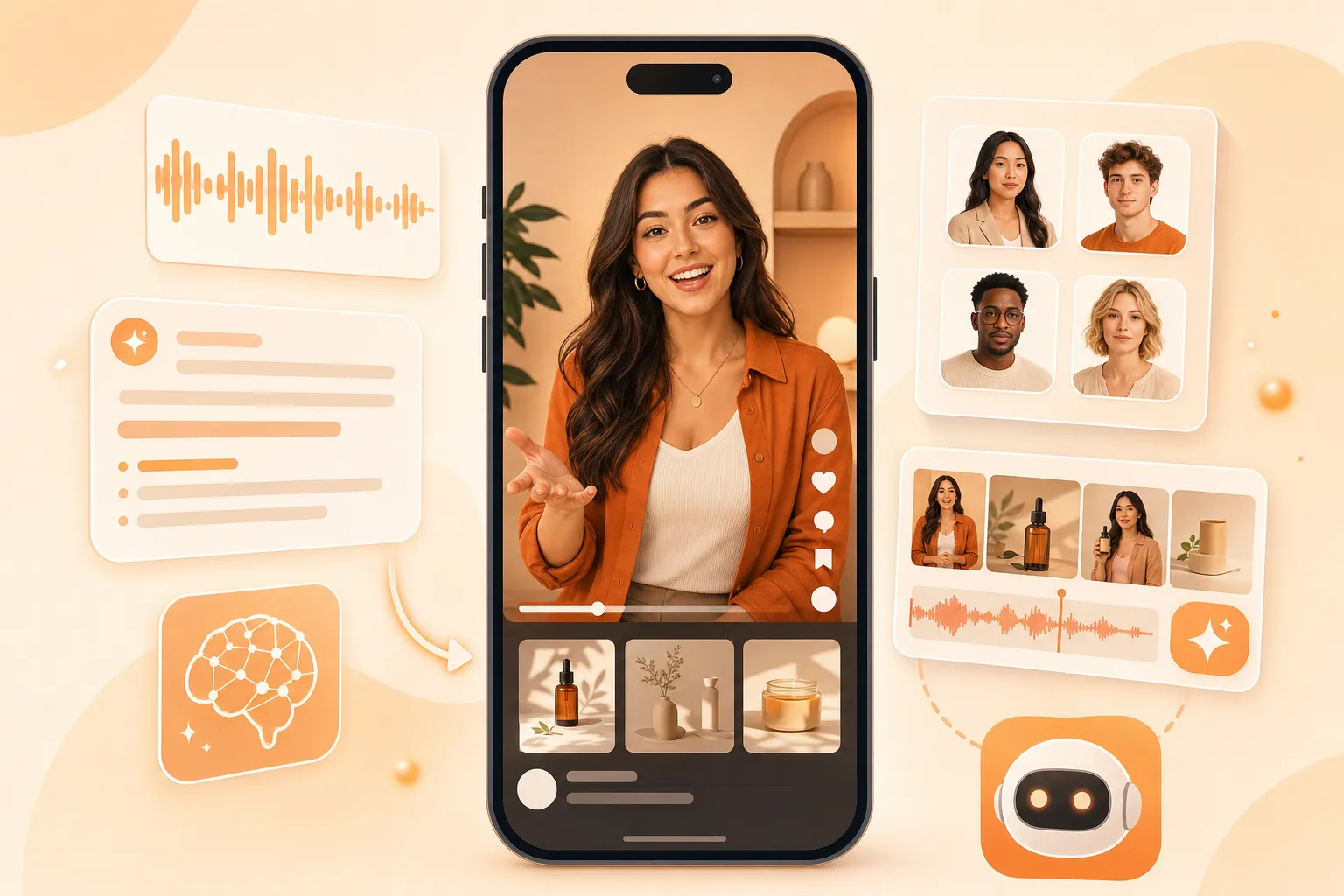
AI UGC ads are paid social video ads that use AI-generated actors, voices, and editing to imitate the casual, talking-to-camera style of user-generated content — without a human creator filming anything. You write (or generate) a script, pick an AI actor from a library, and the platform renders a video that looks like a real person recommending your product from their kitchen, car, or bathroom mirror.
The format works because it inherits the trust signals of organic UGC: handheld framing, conversational delivery, imperfect lighting, native captions. In a feed, a good AI UGC ad reads as a person, not a production. In our experience the best current AI actors — the top tier of Arcads' library, for example — regularly pass as human on first watch.
Three things AI UGC ads are not:
- Not testimonials. An AI actor saying "I used this for 30 days" is a fabricated endorsement. The FTC's endorsement guides apply regardless of whether the endorser is human. Script the actor as a presenter making product claims you can support, not as a fake customer.
- Not undisclosed. TikTok and Meta both require labeling AI-generated content that shows realistic people in realistic scenarios. It's a checkbox in the ad setup — use it.
- Not a replacement for every human video. Founder stories and named-customer testimonials still belong to real people. AI UGC wins the volume game: product demos, hook testing, offer variations, localization.
How to make AI UGC ads in 5 steps
The end-to-end process, tool-agnostic. Total time for a first batch: about an hour, most of it on step 2.
Step 1: Define one product, one audience, one objection
Every UGC ad is a 30-second answer to a single objection. Before touching any tool, write down: the product, the person you're targeting, and the one reason they haven't bought yet (too expensive, doesn't work, too complicated, don't trust it, never heard of it). One ad per objection. Ads that try to answer three objections answer none.
Step 2: Write the script — hook first
A converting AI UGC script is 60–90 words for a 25–35 second video, in four beats:
- Hook (1–2 sentences, ≈8–12 words spoken first). The scroll-stopper. See the formulas section below — this line is 80% of the ad's performance.
- Problem agitation (1–2 sentences). Name the objection from step 1 in the viewer's own words.
- Product + mechanism (2–3 sentences). What it is and why it works. The mechanism ("it uses X to do Y") is what makes the claim believable.
- CTA (1 sentence). One action, plus the price, discount code, or offer.
Write it the way people talk: contractions, short sentences, no adjectives you wouldn't say out loud. Read it aloud once — if you stumble, the AI voice will too.
Step 3: Pick the platform and the actor
Choose your tool (comparison table below), then cast the actor like a media buyer, not a casting director: match the actor's apparent age and setting to your buyer, not to your brand aesthetic. A skincare product for 45+ women should not be presented by a 22-year-old in a gaming chair. Most platforms let you filter by age, setting (car, kitchen, gym), and energy level. When in doubt, pick the least polished-looking actor — polish reads as advertising.
Step 4: Generate variants, not a video
This is where AI changes the job. Don't render one video — render a test matrix from the same base script:
- 3–5 different hooks on the same body script
- 2 different actors (different demographics)
- Optionally 2 CTA/offer framings
That's 6–20 creatives from one writing session. On Prizmad, the pipeline renders script → voice → lip-synced avatar → captioned 9:16 mp4 in about five minutes per video, and you can regenerate a single asset (just the hook line, just the music) instead of re-rendering the whole thing. Whatever tool you use, the principle holds: the marginal video is nearly free, so never launch a single creative.
Step 5: Launch, label, and kill fast
Upload to TikTok Ads Manager or Meta Ads Manager, apply the AI-generated content label, and put equal budget behind each variant — typically $20–$50/day per creative for 3–4 days, enough to get past the learning phase noise. Kill anything with a hook rate (3-second views ÷ impressions) below ≈20% on TikTok or thumbstop under ≈25% on Meta before you even look at CPA. Then scale the winner and write the next batch around the winning hook, not from scratch.
Choosing an AI UGC tool (prices verified July 2026)
We maintain full hands-on reviews of the major platforms — the AI UGC platforms hub has the complete comparison. Here's the short version, with entry pricing verified against each vendor in July 2026:
| Tool | Entry price | What you get at entry | Best for |
|---|---|---|---|
| Prizmad | $39/mo (Launch, 3,000 tokens) | URL-to-ad pipeline: script, avatar, captions, music in one render | Solo founders and small DTC teams who want the full pipeline, not just an avatar layer — see pricing |
| Arcads | ≈$110/mo for 10 videos | 1,000+ AI actors, top-of-category realism | Funded performance teams where actor realism is the priority |
| Creatify | Free (watermarked) / $39/mo Starter | 100 credits (≈20 videos), 300 actors, URL-to-video | Lowest-risk way to evaluate the category |
| MakeUGC | $59/mo (500 credits) | 1,000+ AI creators, 50+ languages, up to 4K export | Volume production and localization |
| TopView | $29/mo, or $16/mo billed annually | All video/image models, 200 saved avatars, commercial license | Budget testing with model flexibility |
Three honest caveats from our reviews:
- Arcads has no public pricing page — arcads.ai/pricing returns a 404, and the ≈$110/mo figure comes from third-party audits since numbers only appear after signup. There's no free plan or trial, which makes it hard to evaluate before paying. Its actor realism is genuinely the best we've tested, but if the commercial model puts you off, we've broken down the Arcads alternatives at every budget level.
- Credit systems vary wildly. Creatify's ≈5 credits per video is the free tier's stated ratio, not a guarantee — real capacity depends on which models and features you use. Model the math for your actual workflow before committing to an annual plan.
- Cheap entry tiers are usually evaluation tiers. Creatify's free plan watermarks everything; several tools gate their best actors, custom avatars, or ad-launcher features behind $99+ plans. Budget for the tier you'll actually produce on.
Hook formulas that carry AI UGC ads
The hook is the first 1.5 seconds. Everything else in this guide matters less than this section. Six formulas that consistently work in the format, with usable copy:
1. The confession. Admit something the viewer suspects.
- "I almost didn't post this because it's embarrassing."
- "I was wrong about greens powders. Mostly."
2. The negative filter. Tell part of the audience to leave — the rest leans in.
- "If your skin is already perfect, skip this ad."
- "Don't buy this if you actually enjoy meal prepping."
3. The specific number. Precision reads as truth.
- "This costs $1.30 a day. My old routine cost $9."
- "I tested 4 of these so you don't have to. One won."
4. The mid-conversation open. Start as if the viewer already asked.
- "Okay so the reason it works is actually kind of boring —"
- "No, it's not the expensive one. Let me show you."
5. The contrarian claim. Attack the category's common wisdom.
- "Your standing desk isn't fixing your back. Here's what will."
- "Stop moisturizing twice a day. Seriously."
6. The result-first. Show or state the outcome, then rewind.
- "This is week six. Watch what week one looked like."
- "My CAC dropped 30% and it was one boring change."
Rules of thumb: never open with the brand name (that's the fastest scroll trigger in the format), keep the spoken hook under 12 words, and make the on-screen caption different from the spoken line — two hooks for the price of one, and most of the feed watches muted anyway.
Common mistakes that kill AI UGC performance
- Studio-grade scripts in a bedroom-grade format. "Introducing the revolutionary…" delivered by a casual avatar is an uncanny mismatch. The script must be as informal as the actor.
- One video, one launch. If you're not testing at least 3 hooks per concept, you're paying AI prices for human-workflow output. Variant volume is the entire point.
- Fake testimonial framing. "I've used this for a month" from an AI actor is an FTC problem and, increasingly, a platform-enforcement problem. Presenter framing ("here's why this works") performs nearly as well and is defensible.
- Skipping the AI disclosure label. Accounts get flagged for this, and repeated flags compound. It's one checkbox.
- Casting for aesthetics instead of audience. The actor should look like your buyer's trusted peer, not your brand's ideal model.
- Judging creatives on CPA at $40 of spend. Early CPA is noise. Judge hook rate first, click-through second, CPA only after each variant has enough conversions to mean something.
- Letting winners fatigue. In fast feeds a winning creative typically decays within 2–4 weeks. Schedule the refresh before CPM starts climbing: same winning hook structure, new actor, new setting.
Measuring results: the CPA math
The business case for AI UGC is not "cheaper videos" — it's more shots on goal for the same budget. Here's the worked example.
Scenario: $3,000/month creative-testing budget, $60 target CPA.
Human UGC route. At ≈$600 per creator video (mid-range on Insense/Billo), $3,000 buys 5 creatives, delivered over 2+ weeks. If, as is typical in our experience, roughly 1 in 8 creatives beats your target CPA, five creatives give you a coin-flip chance of finding zero winners this month. Expected winners: ≈0.6.
AI route. Take Prizmad's Pro plan at $249/mo (35,000 tokens) as the production cost — call it ≈$250 for 35 finished creatives, same day. Put the remaining $2,750 into testing spend: 35 creatives × ≈$78 each of ad spend, enough to read hook rate and CTR on all of them and get real CPA data on the shortlist. At the same 1-in-8 hit rate, expected winners: ≈4.4.
Same $3,000. One route usually produces nothing scalable; the other usually produces three or four creatives you can pour the real budget into. And each winner compounds: a creative that converts at $48 against a $60 target is a 20% CPA improvement on every dollar you scale behind it.
The metrics to track, in order of decision priority:
| Metric | Formula | Kill / scale signal |
|---|---|---|
| Hook rate | 3s views ÷ impressions | Under ≈20%: kill regardless of anything else |
| CTR | Clicks ÷ impressions | Under ≈0.5% with a good hook rate: the offer or CTA is the problem |
| CPA | Spend ÷ conversions | Judge only after ≈2× target CPA in spend per variant |
| Creative-weighted CPA | Blended CPA across the batch | The number that tells you if the program works month over month |
Frequently asked questions
How much does it cost to make AI UGC ads?
Between $16 and $110 per month at entry level, depending on the platform (all prices verified July 2026): TopView starts at $29/mo ($16/mo annual), Prizmad at $39/mo, Creatify at $39/mo after a free watermarked tier, MakeUGC at $59/mo, and Arcads at roughly $110/mo for 10 videos. Per finished video that works out to anywhere from about $1 to $13 — versus $500–$2,000 for a human UGC creator.
Are AI UGC ads allowed on TikTok and Meta?
Yes, on both platforms — provided you label the content as AI-generated when it depicts realistic-looking people, and your claims comply with the same ad policies that govern human-shot ads. The label is a creative setting in the ad manager, not a metadata trick. Undisclosed realistic AI actors are what get ads rejected and accounts flagged.
Do AI UGC ads actually convert?
In product-led categories — where the ad is about the product rather than a person's identity or story — AI UGC ads in our experience perform on par with human UGC, and the ability to test 5–10× more hooks per budget typically produces a better best creative than a single human video would. Human UGC still wins for testimonials, founder stories, and trust-led launches.
What's the best AI UGC tool for beginners?
Creatify's free tier is the lowest-risk way to see the format working (exports are watermarked, so it's evaluation only), and Prizmad's $39/mo Launch plan is a low-cost way to produce ads you can actually run, with the full URL-to-ad pipeline included. Arcads has the most realistic actors but no trial and a ≈$110/mo entry — the full breakdown is in our platforms comparison hub.
How long does it take to make an AI UGC ad?
About five minutes of render time per video once the script exists, on most platforms. The realistic end-to-end number for a first batch — offer definition, script, hook variants, casting, rendering — is about an hour, most of it writing. Subsequent batches are faster because you're iterating on a proven hook rather than starting blank.
Can I use my own face or a customer's face as the AI actor?
Your own face — yes, most platforms support custom avatar cloning on paid tiers (Creatify Pro includes 3 custom avatars, for example), and it's one of the best uses of the format for founder-led brands. Anyone else's face requires their explicit written consent. Never clone customers, competitors, or public figures — that's a right-of-publicity violation on top of a platform ban.
Ready to make your first batch? Paste a product URL into the Prizmad generator and have a TikTok-/Meta-ready 9:16 AI UGC ad in about five minutes — plans start at $39/mo on the pricing page.